


Heatmaps in advertising: see what grabs attention — and try it free


How can a heatmap help improve your ads?

See instantly which elements pull attention and which get ignored. Spot the moments your audience checks out before your message lands.
Run two or three variants side by side and pick the one that actually delivers attention to your brand and message, not just the one that looks best.
Confirm your logo, product, and key visual sit in high-attention zones — not in the cold corners viewers skip over.
Attention is the strongest predictor of memory. Heatmaps tell you whether your ad will be remembered before you spend the media budget.

%201.avif)
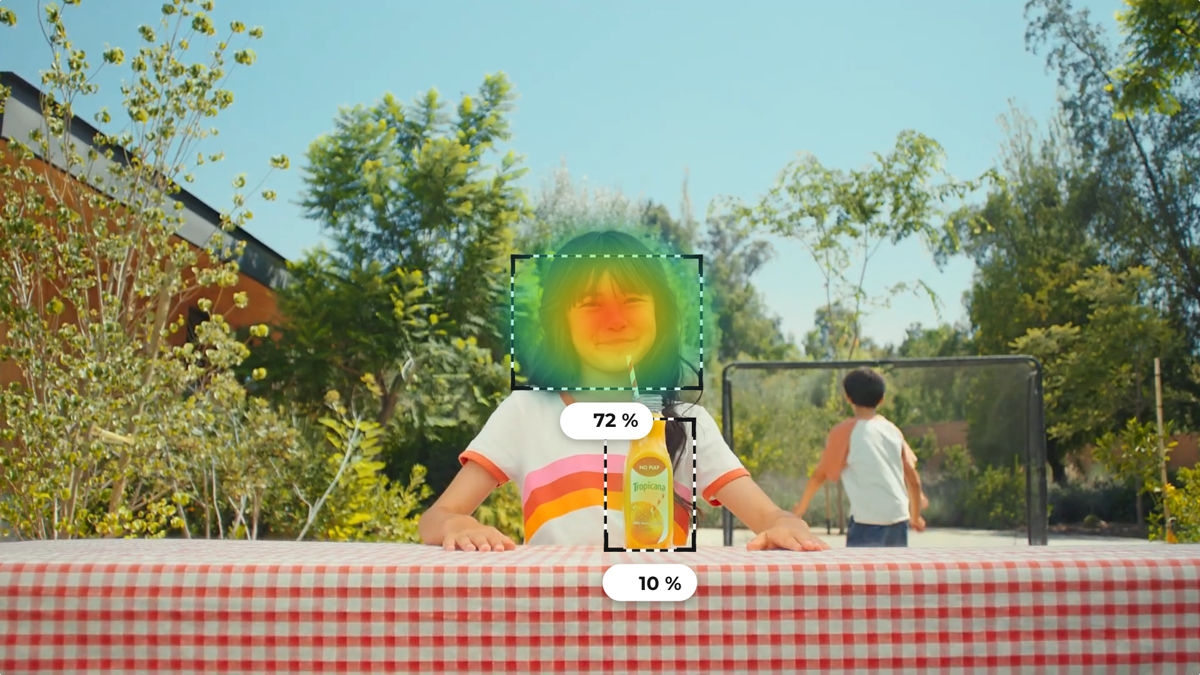
See how much attention each element actually gets
In the ad shown, the central character pulls 70% of viewer attention. The Uber Eats logo gets 5%. The brand message gets 4%. The ad looks fine. The brand barely registers.
Run it before launch. Reposition what isn't pulling its weight. Ship creative that delivers attention to what actually matters.

“Attention heatmaps help spot potential weak spots early – saving costs, time, and energy. Can’t wait to pre-test again!”

“Great to see behavioral science so practically applied to brand building and improving campaigns.”


Got questions? We have answers!
A heatmap in advertising is a visual map of attention. It shows, frame by frame or zone by zone, where viewers' eyes go when they see your ad — and where they don't. Bright "hot" areas mean people are looking. Dark "cold" areas mean those parts of your creative are getting ignored.
This matters because attention is the gateway to memory. If viewers don't notice your logo, your product, or your key message, the rest of the ad doesn't get a chance to land. A heatmap turns "is anyone seeing this?" from a guessing game into a measurement.
Read more on how brands are using heatmaps to boost creative performance →
Behavio's attention heatmaps are powered by the UNISAL model, developed by researchers at the University of Oxford. Built on Google's MobileNetV2 visual architecture, it's trained on 20,000+ eye-tracking experiments to accurately predict what captures attention in both static and moving images.
This means you get scientifically validated predictions of where attention goes, reliable insights to optimize creative design, and results for both video and static visuals — usually in as little as 24 hours.
Upload your creative on this page, fill out the form, and we'll send you the heatmap analysis. It's free for one creative.
If you ask people what they noticed in an ad, they'll tell you what they remember thinking — not what their eyes actually did. People are bad witnesses of their own attention. They overstate what they saw, miss things they did notice, and confuse one ad with another.
Heatmaps measure attention as it happens. They catch the things people would never volunteer in a survey: the logo viewers walked past, the product shot that lost the audience three seconds in, the talent's face that pulled focus away from the message.
In one Behavio test, four fast-food brands got identical visual treatment but recall varied by 14 percentage points — proof that attention and memory aren't the same thing.
Read the full breakdown →
There are three things called "heatmaps" in marketing, and they're not the same:
- Website heatmaps (Hotjar, Microsoft Clarity, Crazy Egg) track where visitors click and scroll on a webpage. They tell you about behaviour on your own site, not about creative performance.
- Lab eye-tracking uses physical equipment to record exactly where a participant's pupils move. Accurate but expensive, slow, and limited to small samples.
- Attention heatmaps (what Behavio runs) measure visual attention to ads at scale, using implicit behavioural methods. Less granular than lab eye-tracking, far faster and cheaper, based on real consumer samples.
If you're optimizing a webpage, use Hotjar. If you're optimizing an ad, use an attention heatmap.
Heatmaps are most useful at three moments in the campaign cycle:
- Before launch. Test 2–3 creative variants and compare. You'll see which version actually delivers attention to the brand and the message — and which one looks great but loses the audience.
- Mid-campaign. If a campaign is underperforming, a heatmap diagnoses why. Often the answer is that the brand cue is in a cold zone or the product appears too late.
- After launch. Post-test against your own creative library to build a benchmark. Brands that systematically heatmap their creative get better at predicting performance over time.
If you're optimizing a webpage, use Hotjar. If you're optimizing an ad, use an attention heatmap.
Ready to see where your audience is looking?



