What are the latest innovations in creative testing methods?
Creative testing is changing fast, thanks to AI and predictive models. Let's take a look at the latest innovations, from AI-powered ad testing and attention heatmaps to synthetic respondents, and learn how to choose what actually makes sense for your team.


The latest innovations in creative testing methods center on one big shift: moving from measuring what already happened to predicting what will happen next.
AI-powered pre-testing, attention heatmaps, emotion measurement, and predictive models trained on real campaign data are starting to replace slower, more expensive legacy methods.
That means faster creative validation, better brand recall prediction, and more confident decisions — before a single respondent sees your ad.
What's actually changing in creative testing?
1. Predictive models trained on real ad test data
The most credible forms of AI-powered creative testing tools, like Behavio’s AI Pre-Test, don’t rely on generic computer vision.
Instead, they use predictive models built on thousands of human responses collected in past ad tests. By learning the patterns, these tests can actually correlate with brand recall, positive emotion, and purchase behavior of real respondents.
2. Attention heatmaps and visual saliency prediction
Attention heatmaps are visual overlays showing where people are likely to look. They have matured from lab tools into scalable pre-testing features.
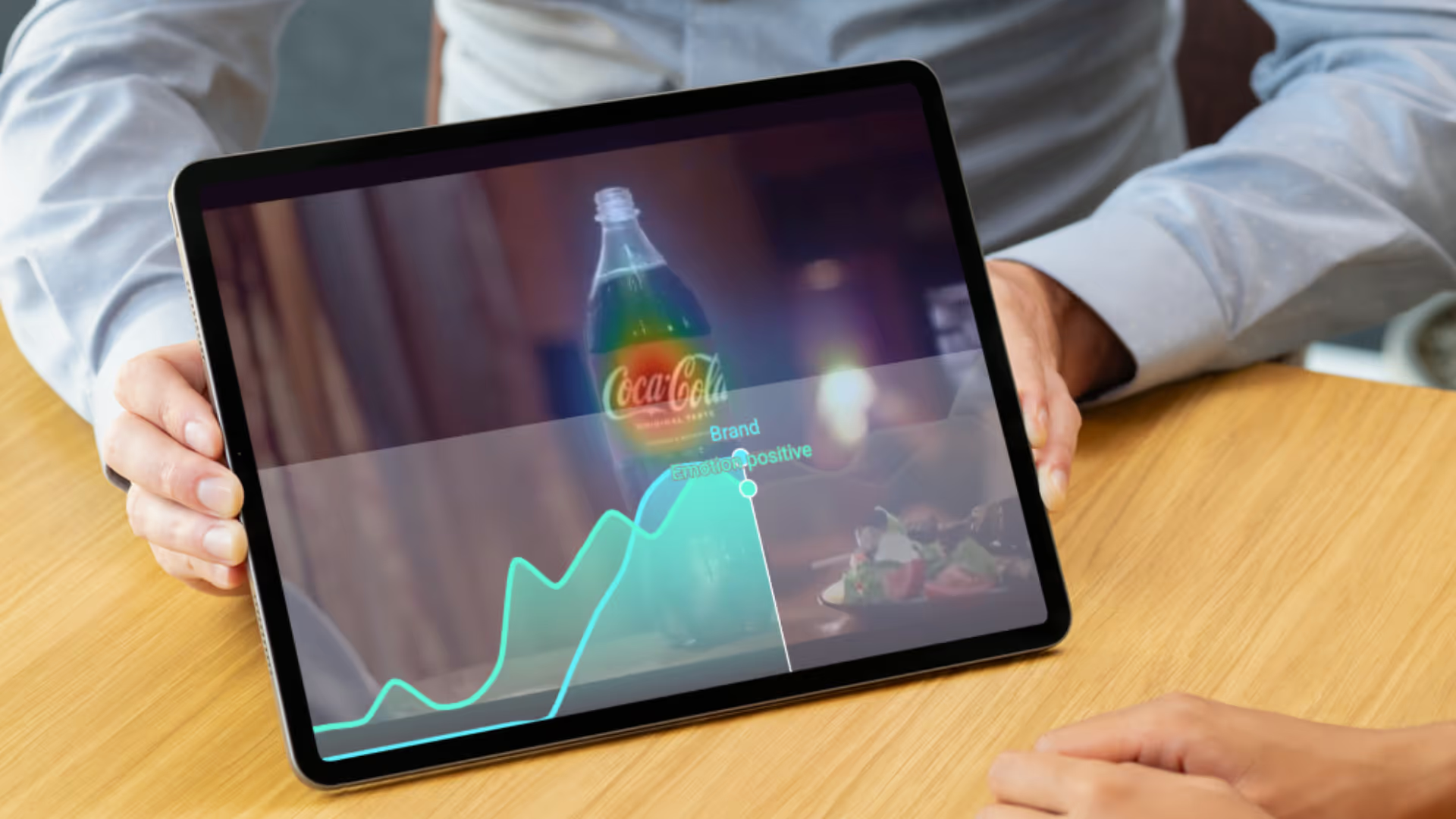
Models trained on eye-tracking data can now generate these maps for both static images and video frames in seconds. For marketers, this answers a critical question: Is our branding visible at the moments that matter?
Heatmaps reveal whether a logo, product shot, or key visual is likely to get noticed or get buried — before media spend is committed.
3. Second-by-second emotion and branding scores for video ads
Testing video creatives used to produce a single overall score. Today's methods go further by mapping second-by-second emotional curves that show how positive or negative reactions shift throughout an ad. Branding curves can also reveal exactly when brand cues become salient.
These tools draw on emotion measurement in advertising research, including decades of work on System 1 (subconscious, fast) versus System 2 (rational, slow) processing.
As Byron Sharp documents in How Brands Grow, mental availability (a brand spontaneously coming to mind) is one of the strongest predictors of purchase. Branding curves help diagnose whether the creative is building that mental availability or wasting it.
4. Synthetic respondents and LLM-simulated audiences
A newer, more experimental approach uses large language models (LLMs) to simulate how different audience segments might respond to a creative. Proponents argue this can dramatically reduce cost and time versus traditional focus groups.
However, the limitations are real. Synthetic respondents are not actual humans, and there are legitimate questions about whether LLM-generated reactions reflect genuine subconscious buying behavior — as opposed to rational, post-hoc explanations.
For early brainstorming, this approach has value. But it is not a substitute for real respondent data for high-stakes campaign decisions.
5. Modular and high-velocity creative testing
Performance marketing teams (particularly those running paid social on Meta, TikTok, and YouTube) have shifted toward testing creative at scale.
The logic is modular: separate a video into hooks (first 1–3 seconds), body, and end card, then test many combinations simultaneously.
Platforms like VidMob and Motion have built intelligence layers on top of ad platform data, tagging creative elements and correlating them with downstream performance. This enables creative optimization at a granularity that was simply not possible five years ago.
6. In-feed and in-context testing
Rather than testing ads in artificial survey environments, some teams now embed creatives directly into real social feeds or streaming environments. This measures attention and engagement during natural scroll behavior, so this isn't really a case of forced exposure.
The tradeoff is interpretability: in-context testing tells you what happened, but less clearly why. Don’t think of this as a substitute for testing, but rather as a useful supplement to pre-testing.
How is AI changing ad testing?
The AI boom has fundamentally altered what's possible in creative effectiveness testing. Where traditional ad pre-testing required days of fieldwork and significant budget, AI-powered tools can now return predictive scores in minutes.
The most obvious benefits are the speed and scalability, but you’d be surprised by the quality of the signal.
Tools trained on human data from real ad test results can now predict brand recall and emotional response with accuracy that approaches respondent-based testing — at least for early-stage screening.
Can you pre-test an ad without real respondents?
Yes, but with important caveats. AI tools like Behavio’s AI Pre-Test can produce credible predictive scores for brand recall, positive emotion, and visual attention without running a single respondent through a survey.
This can be extremely useful for early-stage screening: quickly identifying which of five concepts is most likely to perform before investing in production or full ad testing.
However, AI-only pre-testing is not typically suitable as a final validation step for high-budget campaigns. Results indicate likely performance, but they do not replace actual measured outcomes from real people.
The best workflow uses AI pre-testing to kill weak ideas early, then deploys full respondent-based testing for the finalists.
What's the difference between AI ad testing and traditional ad testing?
The speed vs. accuracy tradeoff is the core issue. AI ad testing wins on agility; respondent-based testing wins on precision.
Forward-thinking marketing teams use both — AI for volume and speed early in the creative development process, full testing for proof before committing media budget.
What metrics can AI predict about ad performance?
Today, AI pre-testing platforms can reliably predict a focused set of metrics:
- Brand recall — the likelihood that someone will remember the brand after exposure
- Positive emotion — the overall emotional valence generated by the creative
- Attention distribution — where viewers are likely to look (via visual attention modeling)
- Branding curve — when and how strongly brand cues register in video ads
What AI pre-testing cannot reliably predict: actual purchase intent at an individual level, long-term brand equity shifts, or performance differences driven by audience targeting and media context. Those require respondent-based creative effectiveness testing and brand tracking.
How accurate are AI-powered Ad pre-tests?
Accuracy depends on what the AI model was trained on. Generic computer vision tools that are not built on advertising data tend to produce surface-level attention predictions that don't correlate well with real campaign outcomes.
Models trained on large-scale, validated ad test data (like Behavio's, built on thousands of real ad test results) produce meaningfully more accurate predictions because they learn from actual human reactions. Still, even the best AI pre-tests should be treated as directional for early screening and creative optimization, not definitive proof of in-market success.
Final thoughts
Behavio's AI Pre-Test is a standalone predictive report available inside the Behavio ad test platform. Users upload a creative (image or video), select a brand, and receive a report within minutes — including branding scores, emotional impact, and heatmaps.
What distinguishes it: the underlying models are trained on thousands of real Behavio ad tests, incorporating actual human responses rather than synthetic data or generic visual patterns. Results are interpreted through Behavio Insights (an AI chat layer), translating scores into clear recommendations.
It is designed explicitly as an early-stage screening tool before a full respondent-based ad testing. Teams can use it to compare 3–5 concept variants, identify attention and branding weaknesses, and decide which ideas warrant full testing investment.
Request early access to AI Pre-Test and be among the first to try instant, predictive ad testing.
Frequently asked questions

Creative testing, also called ad pre-testing or creative effectiveness testing , is the process of evaluating how well an advertising concept, visual, or video is likely to perform before or during a campaign. It measures metrics like brand recall, emotional response, and attention to guide creative decisions.
Prediction speeds validation, but hybrid methods that include real human data often provide deeper, more reliable insights.
Brand recall prediction tools use AI to estimate how likely viewers are to remember the advertised brand after exposure. They analyze cues like logo visibility, brand color presence, product placement, and timing — typically derived from models trained on real ad test recall data.