What DIY shoppers want in 2026, and which retailers actually deliver
Behavio’s market tracking data uncovers which Dutch DIY retailers truly stand out and which ones blend into the background. The findings offer a fresh look at how shoppers think, choose, and remember brands in one of the country’s most crowded categories.
.avif)


The DIY market in the Netherlands is crowded, competitive, and surprisingly emotionally driven.
While the category might look purely functional, consumer needs tell a more nuanced story. Price and reliability still matter, of course, but inspiration, expertise, and the sense of being an “active maker” are increasingly shaping where people choose to shop.
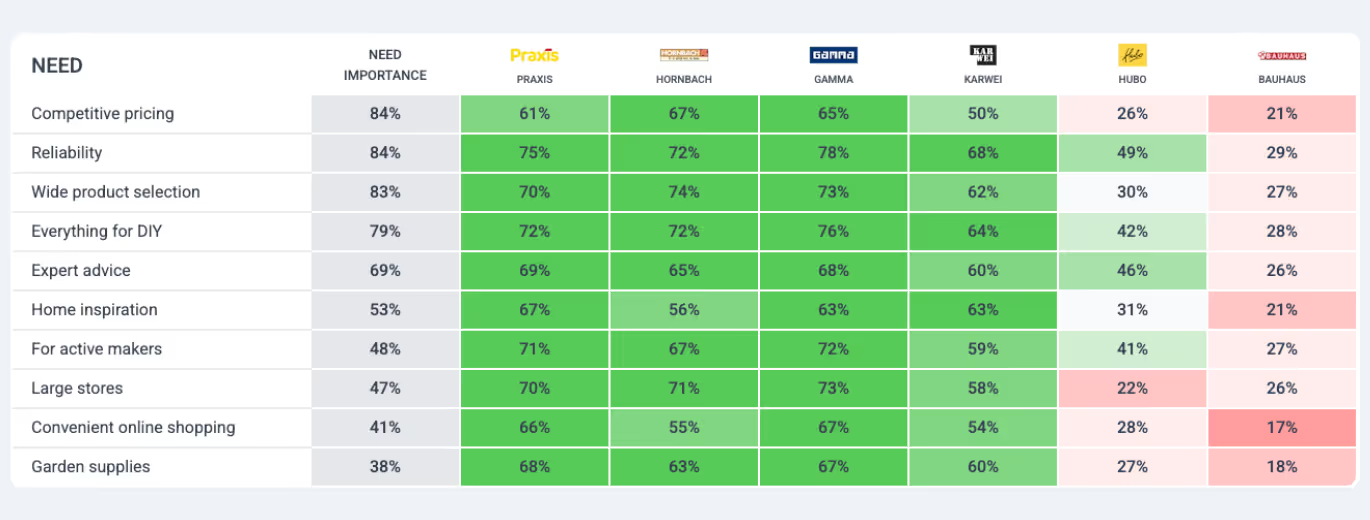
Using Behavio’s market tracking data, we examined how Dutch shoppers associate key needs with each major DIY retailer: Praxis, Hornbach, Gamma, Karwei, Hubo, and Bauhaus.
By comparing each brand’s absolute strengths with their relative differentiation, a clear picture of the mental landscape emerges: who dominates the essentials, who stands out, and who is struggling to define a role.
Here’s what’s really going on inside consumers’ heads.
.avif)
Hornbach: the powerhouse of value and scale
Hornbach has long positioned itself as the no-nonsense, “everything for your project” powerhouse, and the data confirms that this isn’t just advertising bravado.
The brand continues to dominate the Dutch DIY landscape with exceptionally strong associations across almost every high-importance need:
- Competitive pricing (67%)
- Reliability (72%)
- Wide product selection (74%)
These are the backbone needs of the category, and Hornbach isn’t just performing well on them; it’s outperforming everyone else. It also ranks among the leaders for Everything for DIY (72%) and Large stores (71%), reinforcing its big-box reputation.
The takeaway: Hornbach owns the category fundamentals so thoroughly that competing with it head-on is nearly impossible. You don’t out-Hornbach Hornbach.
Praxis: the balanced all-rounder
Praxis is often the most familiar, most accessible brand in urban areas, but the data shows a brand that blends in more than it stands out.
Praxis performs solidly across nearly all needs, without a single sharp weakness or breakthrough. It leads the market in Reliability (75%), and is strong on:
- Everything for DIY (72%)
- Wide product selection (70%)
- For active makers (71%).
…but when viewed against competitors, Praxis sits mostly at slight negatives across the board.
- Competitive pricing: –1%
- Reliability: –4%
- Expert advice: –2%
- Wide product selection: –2%
Nothing is broken, but nothing is uniquely owned either. Praxis is the “everyday dependable” brand of Dutch DIY retail: broadly trusted, accessible, and consistently present, but less distinctive in any one territory.
To compete against global giants like Hornbach, it could benefit from a sharper emotional or functional edge.
Gamma: reliable, versatile, and digitally ready
Gamma’s strength lies in trust and breadth. It leads all brands in Reliability (78%) and Everything for DIY (76%), while also performing very well in Wide product selection (73%) and Convenient online shopping (67%), a standout digital advantage.
Its relative scores are modest but also positive:
- +2% in Competitive pricing
- +3% in Large stores
- +4% in Convenient online shopping
Gamma’s image is that of a stable, well-rounded brand that blends physical and online accessibility with high credibility — a position that keeps it competitive across multiple needs, even without sharp emotional differentiation.
Karwei: design-led inspiration
Karwei has positioned itself as the stylish DIY brand, appealing to homeowners who want “inspiration” just as much as hardware. And here, the data really tells the story.
While it lags on Competitive pricing (50%) and Wide product selection (62%), it shines in Home inspiration (63%), one of the highest emotional needs in the category.
In the relative comparison, Karwei scores +7% in Home inspiration, confirming that its design-first positioning resonates strongly.
Karwei is the only brand meaningfully winning outside the functional dimension. Its future lies in owning the intersection of style + DIY, not trying to compete on basics it can’t win.
Hubo: expertise and personal service
Hubo isn’t a mass big-box retailer, and consumers don’t see it as one. It suffers in areas like:
- Competitive pricing (26%)
- Large stores (22%)
- Wide product selection (30%)
In differentiation terms, Hubo outperforms all others in Expert advice (+11%) and Reliability (+9%). This shows a brand that wins not through size but through trust and expertise, appealing to those who value guidance over discounts.
In short, shoppers see Hubo as the place to go when they need real, hands-on help. Rather than chasing volume-led category drivers, the brand should double down on a “local craftsman support” positioning that reinforces what makes it genuinely distinctive.
Bauhaus: the quiet challenger
Bauhaus remains a smaller player in the Dutch market, with associations among the lowest across all needs:
- Competitive pricing (21%)
- Reliability (29%)
- Wide product selection (27%).
Its differentiation results hover near zero, suggesting that the brand is not yet mentally distinctive among Dutch DIY shoppers.
With no meaningful strengths, Bauhaus has little mental foothold in the Dutch market. It still needs to establish what it stands for, whether that’s premium service, product depth, or something uniquely its own.
What does this mean for the DIY category?
When you step back from individual logos, a clear pattern appears:
- Functional strength dominates, but doesn’t differentiate.
Most brands are strong on reliability, range, and DIY completeness. These are table stakes, not differentiators. - Emotional or experiential needs remain open territory.
Karwei owns inspiration, Hubo owns expertise, but there’s room for brands to claim more emotional ground. - Value and size still drive memory.
Hornbach’s and Gamma’s scale advantages translate directly into mental availability.
The Dutch DIY market shows that true differentiation isn’t about who offers “everything for DIY”... everyone does. It’s about who people remember when they think about value, guidance, or creative inspiration.
Behavio’s market tracking platform reveals that these mental territories are already shifting, and brands that manage to own a moment will own the future of Dutch DIY retail.
Frequently asked questions

Because many retailers offer similar functional benefits — good prices, wide product ranges, and reliability. As a result, brands fight to stand out in an already crowded and mature category.
They should claim a distinct mental territory that competitors can’t easily replicate — whether that’s design inspiration, expert help, great value, or a seamless omnichannel experience.
Hornbach leads across almost all high-importance functional needs, including pricing, reliability, and wide product selection. It owns the category fundamentals more than any other retailer.
- Praxis Market Tracking – Behavio, Nov 2025