What is brand positioning? How to find yours using customer needs and brand size
Brand positioning is the distinct place your brand holds in a customer's mind. Learn how to find yours by measuring which customer needs matter most and which are still up for grabs.


What is brand positioning?
Brand positioning is the distinct place your brand holds in your customer's mind, relative to the brands they could buy instead. It's the need people think of you for when they're standing in the aisle or scrolling the app.
Two things have to line up: the position you're aiming for, and the position you actually hold in people's heads. When those two match, marketing gets easier. When they don't, you're paying media money to shout something nobody connects to you.
Here's the good news. That gap is measurable, and the science behind it is well established. Decades of research from the Ehrenberg-Bass Institute show that brands grow by building memory links to the needs and moments that drive buying, what marketers call mental availability. So you don't have to guess your position. You can measure it.
What is a brand positioning statement?
A brand positioning statement is one or two sentences that spell out who you're for, what need you meet, and why you're the credible choice for it. Most versions follow one pattern:
For [audience], [brand] is the [category] that [meets this specific need], because [reason to believe].
The hard part isn't the sentence. It's picking a need that's both worth owning and still available. The statement is easy to write once you know which need to aim at, and that's a question of data, not wordsmithing.
Skip the generic words while you're at it. "Quality." "Innovative." "Customer-focused." Nobody ever positioned against being bad at those, so claiming them says nothing.
Why most positioning exercises fail
Most positioning gets decided in a workshop. Sticky notes, a two-by-two, three hours, strong coffee, a decision. Everyone leaves happy.
The problem isn't the workshop, but that nothing in the meeting room tells you two crucial things: how many people actually care about the need you picked, and whether a bigger competitor already owns it.
Pick a need nobody cares about, and your message lands with a shrug. Pick a need a market leader already owns, and every dollar you spend quietly reminds people of them instead of you. Both mistakes are invisible in a meeting room. Both are obvious in the data.
But that can be prevented.
How do you find your brand position using customer needs?
Your position sits at the intersection of two numbers:
- Importance: how many people in your market say this need matters when they buy.
- Brand ownership: how strongly they already link that need to a specific brand (including you).
Plot every need on those two axes and the strategy stops being a debate:
- High importance, low ownership is free mind-share. That's your target.
- High importance, already owned by someone bigger is a fight you'll lose slowly and expensively.
- Low importance is a distraction, however easy it is to claim.
.avif)
This is what Behavio's Market Mapping measures. It scores which needs people in your category care about, then shows how strongly each need links to you and to your top five rivals.
Because it uses implicit testing (measuring fast, System 1 memory links rather than what people say in a survey), it reflects the associations that actually drive choice.
Two examples of what that looks like in practice:
Prager’s
Soft drink brand Prager’s wanted to launch its first major campaign for its kombucha. Behavo’s data showed that taste is the biggest purchase driver in the category, but it’s also kombucha’s biggest weakness, with only 36% of people describing the drink as tasty.
Health wasn’t the issue: 68% already associate kombucha with natural ingredients. Instead of reinforcing an existing perception, Behavio recommended that the campaign focus on a specific, data-backed message about great taste to tackle the category’s biggest barrier and resonate more strongly with consumers.
Meatfly
Meatfly, working with agency Digihive, used Behavio to map the online clothing market. The research found that comfort, price, design, quality, and durability matter to 8 or 9 out of 10 shoppers.
Meanwhile, "local brand" and "how long we've been around," both regular messages in Meatfly's communications, barely registered. Knowing what to drop was half the value. See how they used it.
How does brand size change your positioning?
Same map, two very different plays. Behavio classifies brands by how many category buyers they have, from Tiny and Small up to Medium (challenger) and Large (leader), and the right positioning move depends on where you sit.
- If you're a challenger (smaller brand): pick one. One unclaimed need, big enough to fuel growth, hammered consistently. Focus is your only real advantage over a brand with ten times your budget. Spread across five needs and you own none.
- If you're the leader (large brand): defend across all the major needs your audience cares about. You don't get the luxury of a single message, because every need you go quiet on is an opening for someone hungrier.
The bigger you are, the more freedom you have. The smaller you are, the more discipline you need.
How do you build a brand positioning map?
- Define the market as buyers see it, not as your org chart sees it.
- Measure need importance across category buyers and any segment that matters to you.
- Measure brand linkage for you and your top five competitors on each need.
- Read the differentiation view. Big brands score high on everything because they're famous. Relative differences show where a smaller brand punches above its weight.
- Shortlist needs that are high-importance and weakly owned.
- Pressure-test the shortlist. Can you actually deliver it? What would you start doing? What would you stop?
- Write the statement. One idea, in plain language.
How do you know if your positioning is working?
Positioning isn't done when the statement is written down. It's done when people believe it, and it takes time.
Start with Market Mapping to find the need worth owning. Then Brand Tracking is how you watch it happen: which associations are growing, which are stuck, and whether a competitor is creeping into your territory.
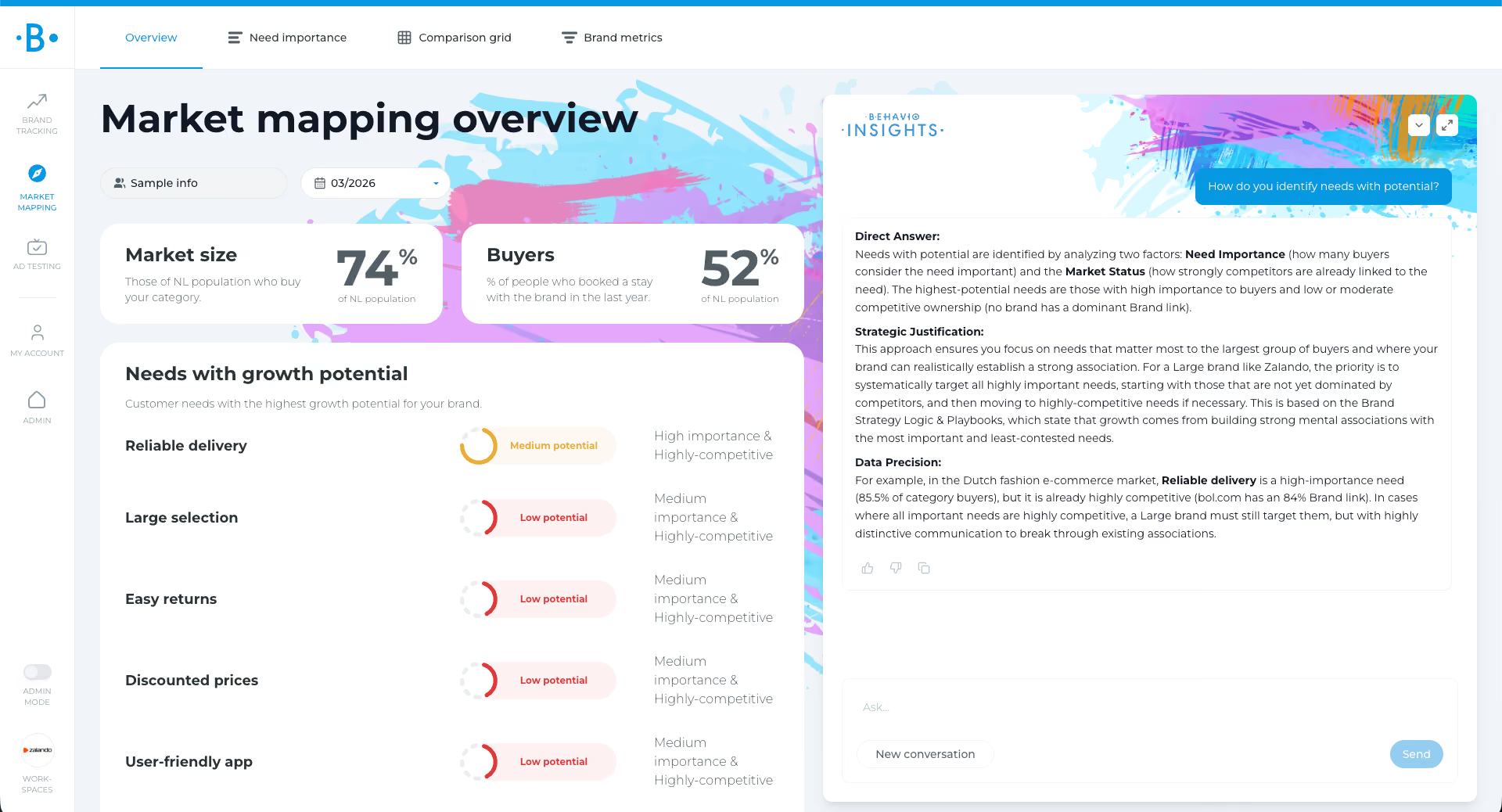
Want to see this in action before you build your own? Take a look at a real category map on the Behavio platform.
Frequently asked questions

A brand positioning statement is one or two sentences naming who your brand is for, the specific need it meets, and why it's the credible choice. A useful version targets a need that's important to buyers and not already owned by a bigger competitor, rather than generic claims like "quality" or "innovative."
Brand positioning is the place your brand holds in customers' minds relative to alternatives, the need they associate with you. Brand identity is what you deliberately put out: your name, logo, colors, tone, and visual style. Identity is what you say about yourself; positioning is what people actually think.
You measure two things for each consumer need in your category: how important the need is to buyers, and how strongly people link that need to your brand versus competitors. Behavio's Market Mapping measures both using implicit (System 1) testing, which captures the fast memory associations that drive real choices better than survey questions do.
Smaller challenger brands should own a single unclaimed need and repeat it consistently, because focus beats budget. Larger, leading brands should defend across all major category needs, because any need they neglect becomes an opening for a competitor.
- How Brands Grow: What Marketers Don't Know. Byron Sharp, Ehrenberg-Bass Institute, Oxford University Press, 2010. The evidence base for mental availability and brand growth through penetration.
- How Brands Grow: Part 2. Jenni Romaniuk and Byron Sharp, Ehrenberg-Bass Institute, Oxford University Press, 2015. Introduces the framework for identifying and measuring Category Entry Points.
- Category Entry Points dissected: how they really contribute to growth. Ehrenberg-Bass Institute for Marketing Science, 2025.
- Finding your place in the market: how to identify the right brand message. Behavio.
- Meatfly + Digihive: data helped us guide the brand in an overcrowded digital space. Behavio case study.