What’s next for Dutch ATL and OOH in 2026
Dutch ads got real in 2025: funny, imperfect, and emotionally sharp. Let's see how this is changing ATL and OOH in 2026.



Dutch advertising in 2025 marked a clear turning point.
Across major brand campaigns and retail categories, a consistent pattern emerged: the work that resonated most strongly abandoned polished perfection in favor of authenticity, humor, and emotional relevance.
This shift has direct implications for how above-the-line (ATL) and out-of-home (OOH) advertising should be approached in 2026. Rather than focusing on louder messaging or broader reach, winning brands are redefining success around emotional territory, audience context, and creative bravery.
The following analysis outlines the key creative and media developments shaping the next phase of ATL and OOH strategy in the Netherlands.
From perfection to personality
For much of the past decade, Dutch advertising, particularly in retail, followed a familiar formula: clean visuals, aspirational imagery, and carefully controlled brand tone. In 2025, that formula began to lose effectiveness.
The campaigns that performed best shared three characteristics:
- A return to humor after years of cautious, corporate-safe communication
- A willingness to take creative risks
- A clear preference for authenticity over idealized perfection
Rather than presenting an ideal version of life, these campaigns reflected life as it actually is: awkward, funny, imperfect, and relatable.
Two widely recognized campaigns illustrate this shift particularly well:
Kruidvat: consistency and realness over idealization
Kruidvat’s continued use of the character “Lies” as its brand ambassador (now for five consecutive years) goes against conventional wisdom in beauty advertising. Instead of rotating faces to maintain novelty, the brand has invested in a consistent personality.
The effectiveness of this approach lies in intentional imperfection. Lies is not presented as a flawless model; her appearance is natural, her skin unretouched. The campaign scenarios are deliberately absurd rather than polished, using humor that feels human rather than manufactured.
This approach directly challenges traditional beauty advertising norms built around unattainable aesthetics and controlled environments. Kruidvat’s positioning is clear: beauty does not require perfection, and accessibility is not a compromise.
The key lesson is not novelty, but continuity. By maintaining a recognizable face and tone while allowing the personality to evolve, Kruidvat demonstrates how consistency can build trust and emotional connection without becoming repetitive.
Albert Heijn: owning an emotional territory
Albert Heijn’s campaign “Dat klinkt als weekend” exemplifies a different but complementary strategy. Rather than focusing on product superiority or operational excellence, the campaign positions the brand as a facilitator of everyday life.
The casting choice — pairing Corry Konings, a well-known older Dutch cultural figure, with Bram Krikke, a Gen Z media personality — appears illogical at first glance. However, that contrast reinforces the campaign’s core message: the weekend is universal, not segmented by age or lifestyle.
Instead of claiming better prices or wider selection, Albert Heijn claims emotional relevance. The brand aligns itself with anticipation, downtime, family moments, and shared routines. By doing so, it moves beyond product messaging into emotional ownership, an area far less vulnerable to competitive imitation.
A broader creative pattern
Taken together, these campaigns reflect a broader creative pattern in Dutch advertising:
- Brand identity is more influential than product claims
- Emotional clarity outweighs functional differentiation
- Relatability drives stronger long-term brand associations than aspiration
This creative evolution is not isolated from media strategy. In fact, it aligns closely with fundamental changes in how OOH is planned and activated.
How the OOH market is evolving
Audience context over physical location
Traditional OOH planning prioritized location quality and estimated reach. In 2026, the focus is shifting toward audience mindset and situational context.
The same physical space can represent entirely different emotional states depending on time, weather, or daily routine. A business district during the morning commute demands different messaging than the same space in the early evening. Effective OOH now responds to these nuances.
This shift allows brands, especially in categories like DIY and cosmetics, to engage consumers during moments of consideration, motivation, or decision-making, rather than relying solely on broad exposure.
Digital OOH as a strategic growth driver
Digital out-of-home is expanding more rapidly in the Netherlands than in many other markets. Its growth is driven by capabilities that traditional OOH lacks: real-time messaging, programmatic buying, and measurable interaction.
Dynamic creative allows brands to respond to immediate conditions such as time of day, weather, or location-specific behavior. When integrated with mobile, CRM, and retargeting systems, DOOH becomes a connective layer between physical presence and digital engagement.
Rather than functioning as a standalone awareness channel, DOOH increasingly serves as the first step in an omnichannel consumer journey.
OOH as the trigger, not the endpoint
Recent data indicates significantly higher mobile engagement following exposure to digital OOH. This confirms a structural shift in the role of OOH: it is no longer the final touchpoint, but the catalyst.
QR codes, mobile landing experiences, and location-based follow-up enable OOH to drive measurable action without sacrificing its brand-building strengths. For advertisers, this bridges the historical divide between ATL effectiveness and performance accountability.
Implications for retail categories
The impact of these shifts is particularly pronounced in DIY and cosmetics retail.
DIY brands competing in the same physical environments can no longer rely on functional messaging alone. Differentiation increasingly depends on which emotional territory each brand owns, whether that’s confidence, empowerment, simplicity, or problem-solving.
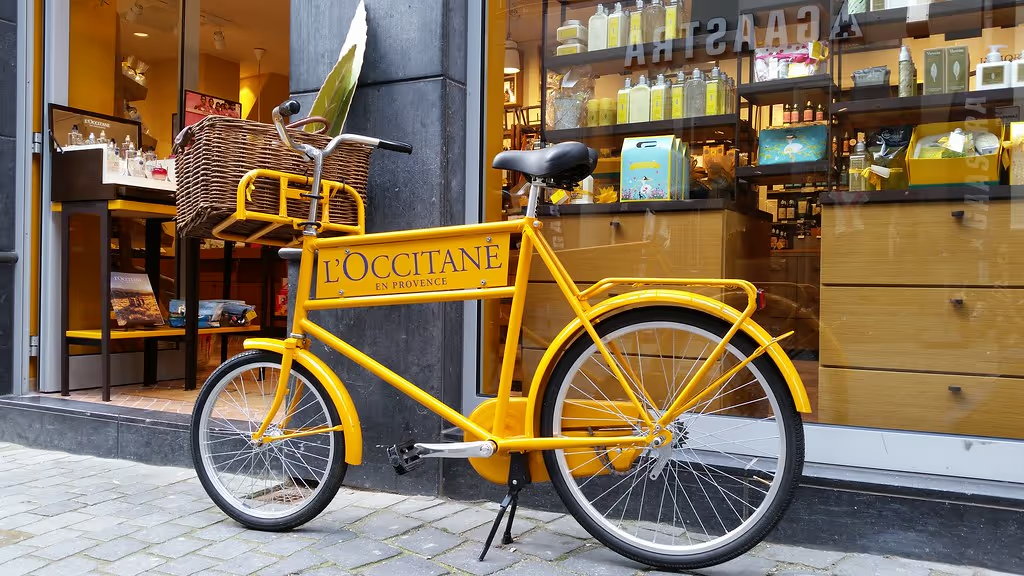
In cosmetics, brands that move away from perfection-driven narratives toward real, accessible beauty are showing stronger resonance. Emotional relevance, rather than premium signaling, is becoming the primary driver of engagement.
Strategic priorities for 2026
Looking ahead, three priorities stand out for brands investing in Dutch ATL and OOH:
- Define emotional ownership. Sustainable differentiation comes from owning a feeling, not a feature.
- Balance brand building With measurability. OOH is evolving into a channel that can deliver both long-term brand equity and short-term interaction.
- Embrace authentic creative risk. The strongest campaigns are not safe, but they are honest. Authentic risk builds connection; risk avoidance builds invisibility.
Final thoughts
Dutch advertising in 2025 demonstrated that effectiveness no longer depends on polish or perfection. The future of ATL and OOH lies in emotional clarity, contextual relevance, and creative confidence.
As OOH becomes more dynamic and more connected to digital behavior, the brands that succeed in 2026 will be those that understand not just where their audiences are, but how they feel in the moments that matter.
Frequently asked questions

Brands shifted from polished perfection to authenticity, humor, and emotional relevance.
OOH is becoming dynamic and context-driven, using digital tools to engage audiences in real time and link to mobile experiences.
Audiences in 2026 are responding more strongly to relatable, human stories than to idealized or purely functional messaging.