.avif)


Ad testing tools are platforms that predict how an ad will perform before you spend money running it, by showing the creative to real people (or, in some cases, an AI model) and scoring how well it lands.
The best ad testing tools in 2026 are Kantar (the market leader on benchmark scale), System1 (the behavioral-science pioneer), Behavio (the best price-to-quality option for growing brands), OnePulse (the fastest survey tool), and VidMob (AI-only creative analysis).
The right one depends on three things: how strong a method you need, how fast you need results, and your budget.
A failed campaign can mean thousands of dollars wasted, so checking whether your creative works before it airs protects both your brand and your media spend.
This guide breaks down five of the most-used ad testing tools, what each does well, where each falls short, and what they cost — so you can pick the right one by the end.
.avif)
What is ad testing?
Ad testing (also called ad pre-testing or creative testing) is a method for evaluating various ad formats at different stages of development to determine their effectiveness and how well they resonate with your target audience.
For a deeper dive into the basics of ad testing and how it can boost your ROI, check out our guide on the topic.
Sadly, ad testing isn’t a simple process that most brands or agencies can take on themselves. That’s why many turn to proven solutions that take on the heavy lifting — phew!
But here comes the hard part, with so many ad testing tools out there, how can you possibly decide which one is right for your brand?
How do you choose an ad testing tool?
Pick an ad testing tool by weighing three trade-offs: method strength, speed, and price.
- Method strength. Tools built on behavioral science (measuring real reactions, not just stated opinions) predict commercial impact more reliably than simple survey tools or pure-AI scorers.
- Sample size. A bigger, representative sample gives more reliable results. Industry defaults range from ~150 respondents up to 500 or more.
- Speed. Turnaround runs from minutes (quick survey tools) to several days (deeper behavioral methods).
- Price. Per-test cost ranges from a few hundred dollars for light survey tools to $11,000+ for enterprise-grade pre-tests.
If time isn't critical, lead with method strength inside your budget. If you need an answer today, you'll trade some rigor for speed.
Kantar: the market leader
Kantar is the largest player in market research, best known for its respondent network across more than 90 markets.
Its ad testing solution, LINK+ (launched June 2023), measures the impact of digital, TV, print, and outdoor creatives, and comes as an automated, self-serve, or fully serviced option.
Where it's strong. LINK+ runs on Kantar's ad testing database of 260,000+ ads, so you can benchmark your campaign against a wide set of competitors and industry norms. Its automated option can turn around results in as little as six hours — useful when you're against the clock.
Where it's limited. Kantar's method is largely survey-based, so it has less of the behavioral nuance that better predicts commercial impact. LINK+ doesn't give you second-by-second emotional reads or verbatim open-ended responses, and it typically runs on a sample of around 150, which can limit how reliable and generalizable the results are.
Pricing. Depends on market and service level. In the US, self-serve starts around $4,500; serviced options begin near $8,080 and often run up to $15,000.
System1: the methodology pioneer
System1 (originally BrainJuicer) pioneered predicting an ad's commercial success using behavioral science instead of stated-opinion surveys. That shift away from traditional methods raised the bar for how accurately the industry can pre-test ads.

Where it's strong. Its Test Your Ad platform predicts commercial potential using behavioral metrics like emotional response and brand fluency, and splits results between long-term share growth and short-term sales. Its FaceTrace feature tracks real-time emotional reactions to each moment of the creative.
Where it's limited. Like Kantar, System1 usually runs on a sample of around 150 — well below tools like Behavio that use 500 or more. Its method also leans heavily on emotional response for long-term effectiveness, and measures fluency by how many viewers recognize the brand at the end of the video, which may not reflect the attention the ad actually earned. (The accuracy of facial-coding tech is still debated among researchers.)
Pricing. Marketers choose from several products depending on depth. The Pro option starts at $11,250 per ad.
Behavio: the best price-to-quality
Behavio is an ad testing tool built for growing B2C brands that want behavioral-science rigor without enterprise pricing.
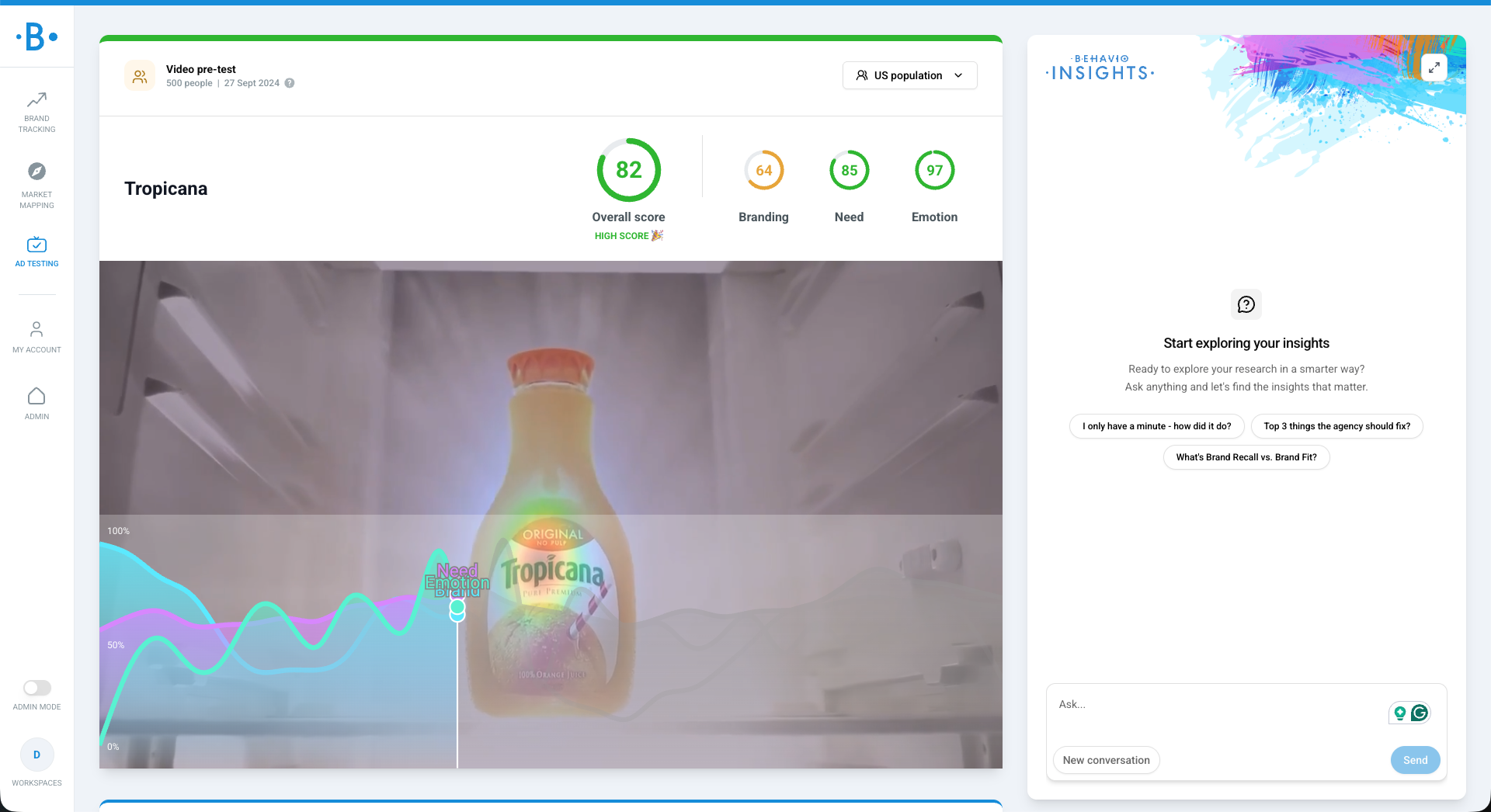
It combines quantitative and qualitative data — including subconscious behavioral measures that predict sales — to score creatives on branding, need (message), and emotion against live benchmarks.
As Hannah Montana puts it, it’s the best of both worlds.
Its core ad testing product is the Full Pre-test: a quantitative and qualitative test run with a nationally representative sample of 500+ real people, using methods like randomized control trials (RCTs), implicit association tests, and emotional diagnostics.
Where it's strong.
- Bigger sample. 500 respondents per test is more than three times Kantar's and System1's defaults, which improves precision and representative coverage.
- Quant + qual in one. On top of the numbers, you get focus-group-style depth: second-by-second emotion word clouds and verbatim quotes from respondents.
- A clear next step. Behavio's 'Key Insight' feature and AI chatbot turns each result into a specific recommendation for improving the creative — not just a score, but exactly what to change.
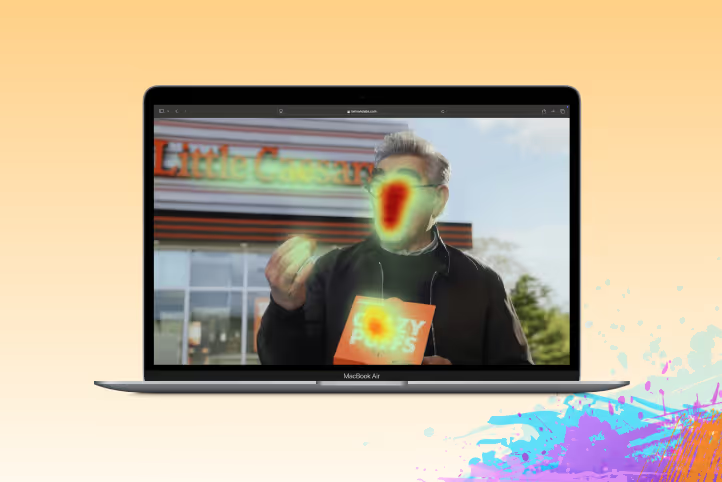
For teams testing at higher volume, Behavio also offers AI Pre-test — an instant, AI-only check that gives an early read on a creative (attention heatmaps, brand recall, emotional breakdown) in seconds, with no respondents. It's a fast way to screen lots of concepts or iterate quickly, then run the Full Pre-test on the ones worth backing with real budget.
Where it's limited. Because of the larger sample and deeper method, Behavio's Full Pre-test turnaround of 3–7 days can't match a six-hour survey tool, though AI Pre-test closes that gap, returning results in as little as 15 minutes when you need an instant read. It also draws on benchmarks from currently aired ads rather than Kantar's larger historical database, and doesn't segment benchmarks by industry or channel the way System1 does.
Pricing. Behavio sells annual plans plus per-test pricing:
- Starter — $3,000/year, 1 Full Pre-test ($3,000/test), 500-person sample, sec-by-sec diagnostics, AI attention heatmap, results in 7 days.
- Pro — $12,500/year, 5 Full Pre-tests ($2,500/test), 5-day results, post-tests, expert consultation, slide export, custom audiences.
- Ultimate — custom, $2,000/test, 3-day express option, dedicated team, custom questions, annual deep-dive.
OnePulse: the fastest tool
OnePulse is a quick-survey platform that returns hundreds of responses in as little as 10 minutes, the fastest option here when you need a read on a concept right now.
Where it's strong. You can build and send an ad testing survey in minutes, with an AI editor to draft questions, auto-translations, and AI-powered result analysis to speed everything up. It won't match the depth of a behavioral pre-test, but it gives you a fast snapshot of how consumers react.
Where it's limited. Quick survey tools are more prone to response bias and error than behavioral methods. Where Behavio uses techniques to filter out dishonest or invalid answers, fast tools do little to correct for low-quality responses or non-representative samples. OnePulse also won't tell you what to do next; it can show the ad isn't landing, but not how to fix it.
VidMob: AI-powered creative analysis
VidMob is an AI-only ad testing tool: instead of surveying respondents, it scores creatives against platform best practices using AI, flagging specific elements or moments to improve.
Where it's strong. Useful for teams testing a high volume of creative. Its strengths are speed, efficiency, and a tight focus on revenue, and it checks assets against platform, brand, and DEI best practices before they go live.
Where it's limited. VidMob reads social signals like clicks and impressions to gauge performance — and those don't always track to actual sales. A high impression count doesn't mean people paid attention. Tools built on behavioral metrics give a clearer picture of how people truly feel about an ad and how it might move sales.
What's the best ad testing tool?
We’d love to give you a definitive answer (*cough* Behavio), but the reality is that each ad testing solution has its own pros and cons. The right choice ultimately depends on your method needs, speed, and budget.
- Need the biggest benchmark database? Kantar.
- Want the deepest behavioral methodology and have enterprise budget? System1.
- Want behavioral rigor and a clear next step at a challenger-brand price? Behavio.
- Need a rough read in minutes? OnePulse.
- Testing high volumes of creative with AI? VidMob.
%25252520(3).avif)
If time isn't critical, pick the strongest method that fits your budget, book a few demos, and test each against your real pain points.
Curious whether Behavio fits your team? Let us convince you – book a demo.
Frequently asked questions

Ad testing is a method for measuring how well an ad will perform before you launch it. You show the creative to a sample of your target audience and score it on branding, message, and emotion, usually against category benchmarks, so you know which version to run before spending media budget.
For any campaign with real media spend behind it, usually yes. A pre-test typically costs a fraction of a media flight, so catching a weak ad before launch protects the budget. Tools built on behavioral science predict commercial impact more reliably than survey-only or AI-only tools, which is why they're the standard for higher-stakes campaigns.
It ranges widely by method and depth. Quick survey tools cost from a few hundred dollars per study; behavioral pre-tests run from about $2,000 to $3,000 per test at Behavio, around $4,500+ for Kantar's self-serve LINK+, and $11,250 per ad for System1's Pro option. Most providers tier pricing by sample size, speed, and service level.