How AI-driven behavioral research shows what truly works in marketing
AI-driven behavioral research replaces misleading click metrics by showing how ads truly work. By combining real human data with predictive AI, marketers can finally see which campaigns drive genuine brand lift and sales, not just surface-level engagement.


Marketing faces a perennial challenge: proving the real revenue impact of campaigns. While clicks are the easiest metric to track these days, relying on them can be misleading…much like the historical “Rat Tail Metric.”
The problem with the “Rat Tail Metric”
History shows that measuring the easiest-to-collect data can backfire. In 1902, the French government in Vietnam attempted to curb the plague by paying bounties for every killed rat, requiring proof via the rat’s tail.
At first, the program seemed successful: the number of collected tails soared. Yet officials soon discovered tail-less rats wandering the streets. Catchers had been cutting tails and releasing the rats to earn more bounties. The metric looked impressive, but the plague worsened.

Clicks in marketing are today’s “Rat Tail Metric.” A 2025 survey of CMOs found that while 80% measure clicks and last-click attribution, only 20% trust them.
Many campaigns appear successful on paper but fail to prove real business impact. In fact, 64% of CMOs cite “inability to prove revenue impact” as their biggest challenge. Clicks are easy to measure, but often unreliable.
Why clicks don’t prove revenue impact
Clicks fail for two main reasons. First, ads drive sales through memory, not immediate action. Most people (around 95%) aren’t ready to buy the moment they see an ad, so they won’t click on it. The real value of advertising comes from being remembered at the right moment, and measuring memory has traditionally been slow, expensive, and complex.
Second, revenue is influenced by countless external factors beyond the ad itself. Market demand, brand reach, and even physical availability all play a role, making it difficult to isolate the campaign’s true impact.
How AI solves the measurement problem
This is where AI-driven behavioral research changes the game. By leveraging AI, marketers can now measure memory and account for external factors faster and more accurately than traditional methods.
Using an AI Expert growth model connected to real human data, this approach can closely mirror real-world responses. AI can predict emotional reactions and brand recall on a second-by-second basis.
Beyond tracking individual responses, the system provides insights into overall brand health and offers competitive intelligence, helping marketers make smarter, data-driven decisions.
Micazu
Take the Dutch vacation rental platform Micazu as an example. We tested one of its recent campaigns using Behavio’s ad testing tool, and it scored just 35 for overall effectiveness. The branding appeared too late in the ad, which limited its ability to build mental availability.
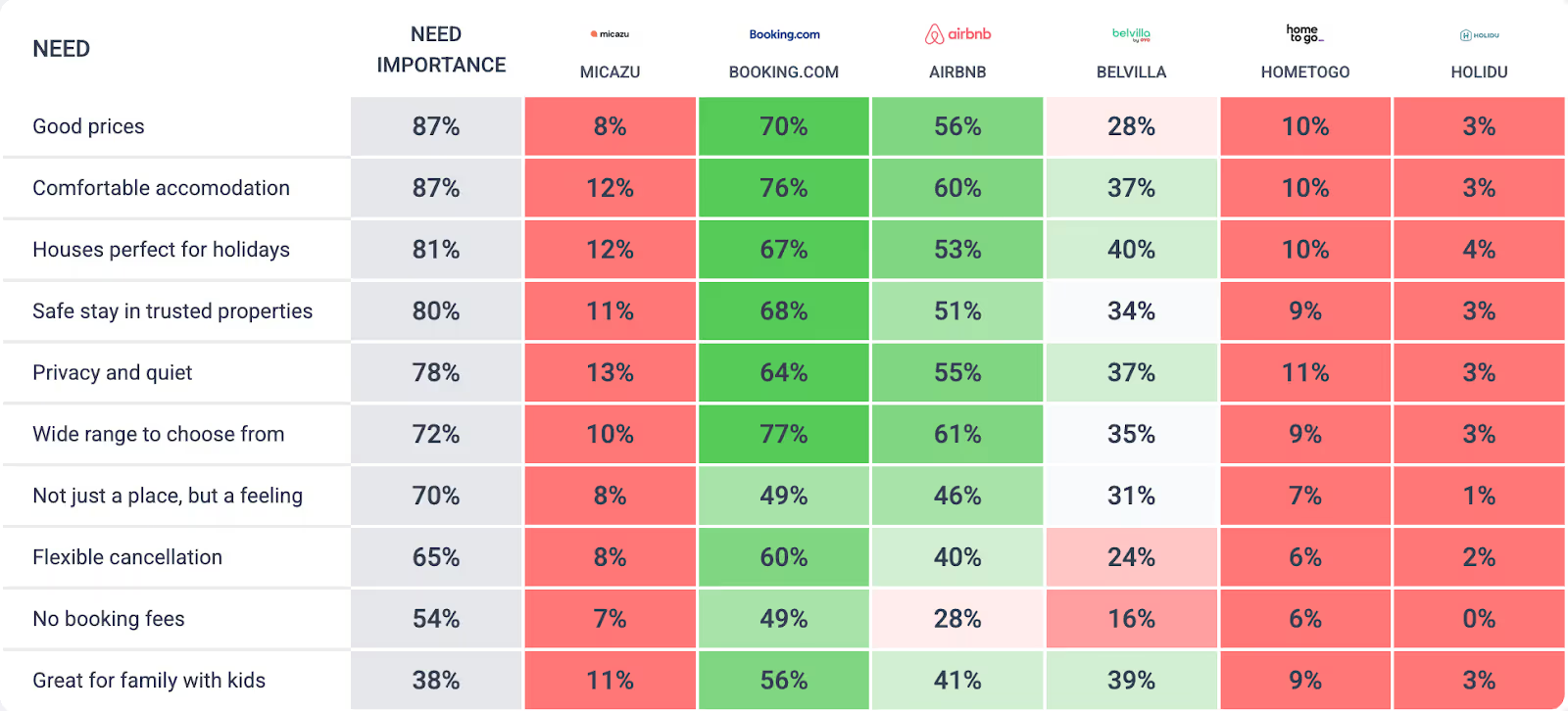
On top of that, Behavio’s market tracking tool revealed a bigger challenge: the Dutch vacation rental market is already dominated by Booking.com and Airbnb.
For the key message Micazu wanted to convey (“houses perfect for holidays”) only 12% of the audience associated this need with Micazu. This shows that the campaign struggled not only because of weak creative execution but also due to a lack of distinct market positioning.
Lidl
In contrast to Micazu’s case, Lidl’s XXL campaign achieved an impressive effectiveness score of 84. Brand recall was high at 94, and the key message ("get more for the same price”) was communicated clearly.

Demand and reach were strong, but market tracking revealed a bottleneck: physical availability in the Netherlands limited purchases, showing that even great creative can only go so far if operational factors aren’t optimized.
Final thoughts
Clicks alone are like counting rat tails: they can mislead and mask the true performance of your campaigns.
AI-driven behavioral research enables marketers to measure what really matters, separating creative effectiveness from external factors, and giving a clear view of the path from awareness to purchase.
Frequently asked questions

Clicks fail to show true impact for two main reasons:
- Ads drive sales through memory, not immediate action: Most people (≈95%) aren’t ready to buy immediately after seeing an ad, so clicks miss the effect of brand recall.
- Revenue is influenced by external factors: Market demand, brand reach, and availability all affect sales, making it hard to isolate the ad’s true impact.
AI-driven behavioral research can measure memory and account for external factors more accurately and quickly than traditional methods. AI models connected to real human data can predict emotional reactions, brand recall, and purchase intent, giving marketers a clear view of how awareness translates into sales.