Introducing 4P Brand Tracking: find out which P is holding your brand back
Product tests well but the brand isn't growing? 4P Brand Tracking measures product, price, place, and promotion, with a clear next step for each.
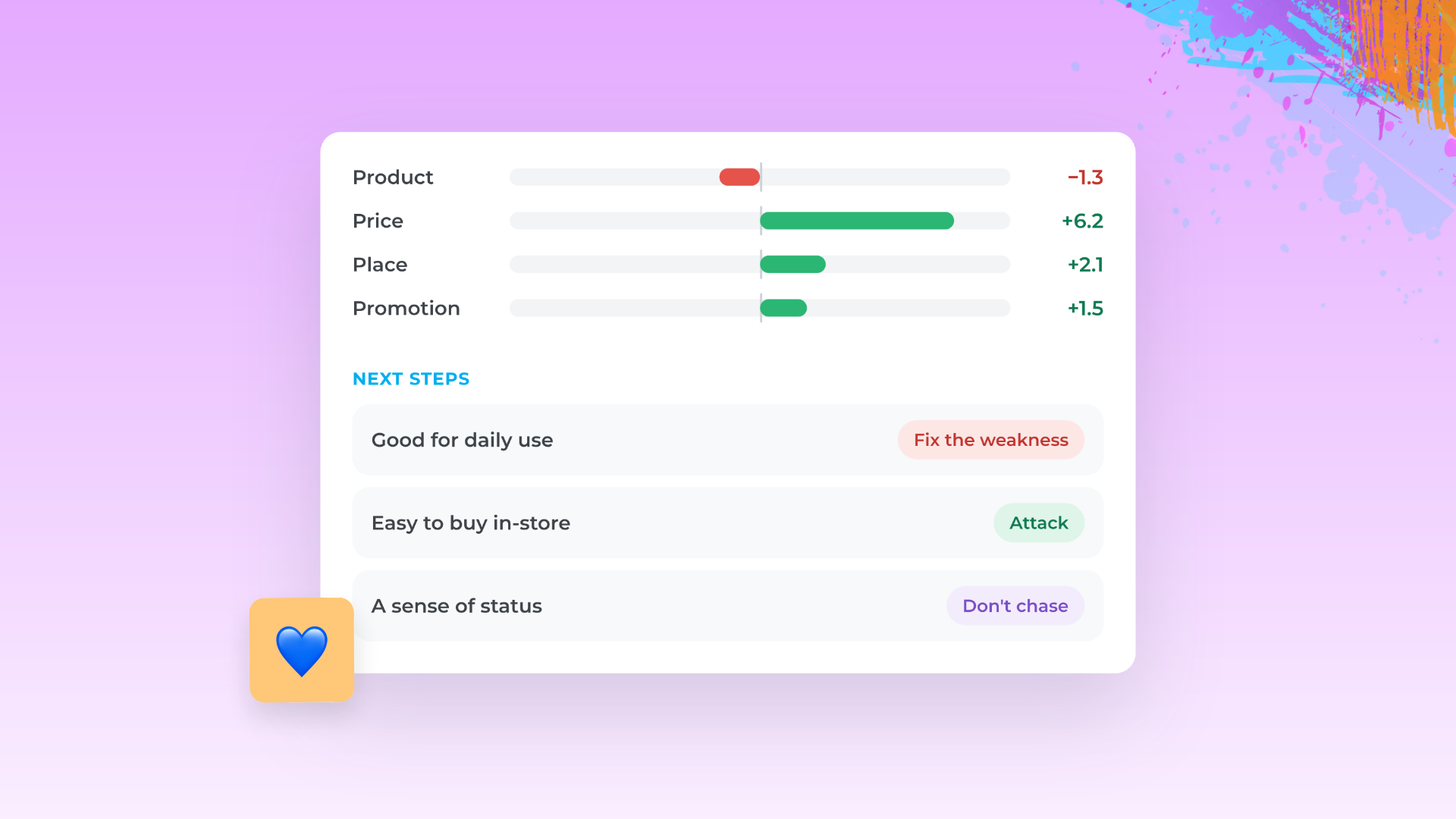
Your product tests well. People say they like it. Your tracker looks healthy. And yet the brand isn't growing.
If that sounds familiar, you're in good company. When Behavio's researchers measured 246 brands across 5 markets, they found that 3 in 4 brands scoring above their size on product fell below their size on price, place, or promotion. The product was fine. Something else was holding the brand back.
A classic brand tracker won't show you what that something is, because it mostly looks at the product. So we built 4P Brand Tracking, plus a one-wave starting point: 4P Market Mapping. Both measure what buyers remember about your brand across the whole marketing mix: product, price, place, and promotion. And both end with a clear next step for each.
Here's what each one does, what you get, and how they build on the Brand Tracking you may already use.
Why isn't product enough to explain brand growth?
People don't choose a brand based on the product alone. They also choose on what they remember about its price, how easy it is to buy, and whether its ads come to mind. Those memories are just as real as product memories, and just as fast: in Behavio's research, buyers answered questions about price, place, and promotion within 3 seconds, just as quickly as questions about product.
They're also where many brands win. Roughly 3 in 4 brands have their biggest strength outside the product: about a third in price, a quarter in promotion, and a fifth in place.

Four brands from the study show what a product-only view misses. All scores are points above or below what each brand's size predicts:
- Davidoff (coffee, Czechia): Product is 10 points above its size, yet only 21% of buyers choose it. People see it as less of a bargain, and it's harder to find in supermarkets.
- Jihlavanka (coffee, Czechia): No product edge at all, yet 37% buy it. Price is 11 points above its size, and promotion is 12 above.
- Dr. Max (supplements, Czechia): Weak on product and on recall, yet 63% buy it. Place and price carry the brand.
- Dr Pepper (cola, UK): People know it, but don't think of it when choosing. Promotion is 10 points below its size, so the ads aren't being linked to the brand.
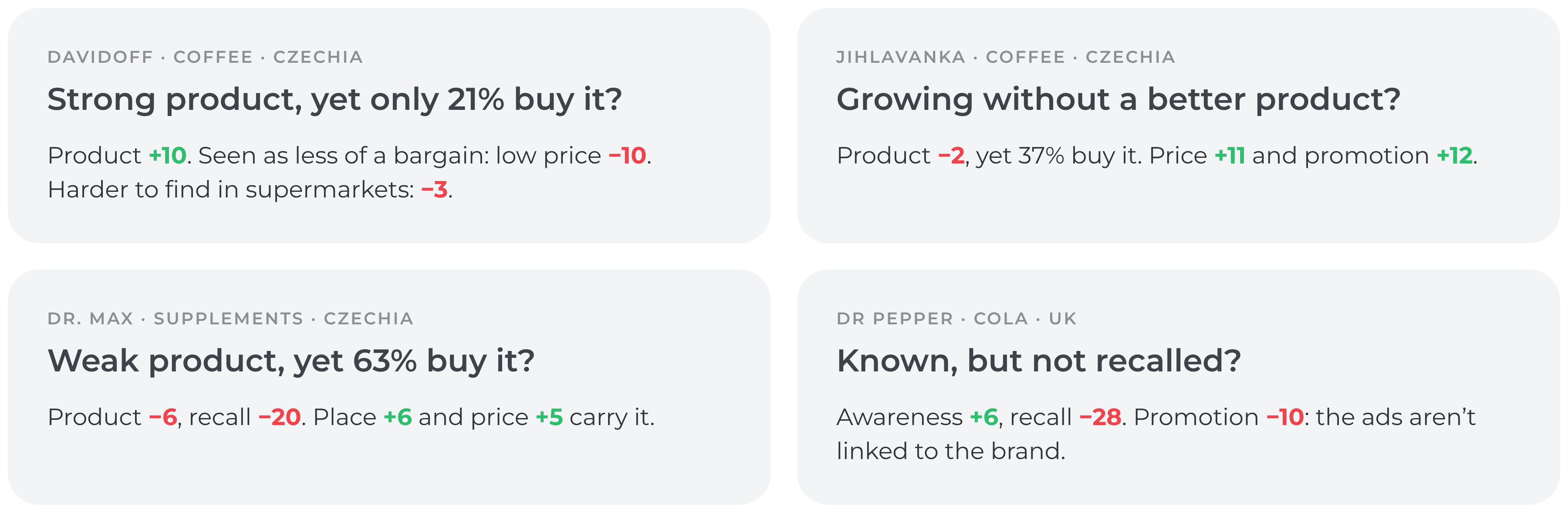
A product-only brand tracker would call Davidoff healthy and Jihlavanka weak. But when seen across all four Ps, the story flips.
What is 4P Brand Tracking?
4P Brand Tracking shows what buyers associate with your brand across all four Ps. It tracks 20 buying needs for your brand and five competitors. Most needs still focus on product; the rest cover price, place, and promotion.
Three things make it work:
It measures buyer perceptions, not company facts. We don’t count your stores or check your price list. We find out whether buyers see your brand as good value, easy to buy, or familiar, because those perceptions shape choice, and can differ from what your company assumes. You might cut prices to look more affordable, only to find buyers already saw you as good value.
It uses the same method for every P. Every need is measured with Behavio's implicit method: a fast yes or no, with slow answers dropped. So a price score and a product score sit on the same scale, and you can compare them directly.
It accounts for brand size. Big brands score high on almost everything simply because more people know and buy them. Around 90% of brand associations reflect brand size. 4P Brand Tracking adjusts scores for what’s typical at your brand’s size, so you can see where you’re genuinely ahead or behind.
The tracker runs at least two waves a year: one full wave covering all 20 needs, plus lighter waves focused on about five key attributes. You also get ongoing tracking of your brand KPIs, a read on what changed between waves, and help setting annual targets.
What is 4P Market Mapping?
4P Market Mapping is the same 4P diagnostic, run once. It's the easiest way to see where your brand stands across the whole marketing mix before you commit to tracking.
In one wave, you get your brand and 5 competitors measured on 20 needs across product, price, place, and promotion. That includes how much each need matters to buyers, which brands own which needs, brand metrics (awareness, emotions, buyers, and likeability), category metrics, and target group profiles. Results land in easy-to-read dashboards you can export to slides, with respondents' own words alongside the numbers.
It takes about 2 weeks from setup to next steps, and costs €12,500 ($12,500) for one wave. When you're ready to watch those needs move over time, you can continue with 4P Brand Tracking.
What do you get from 4P Brand Tracking and 4P Market Mapping?
1. Which P is holding your brand back
You get a score for each P that shows where your brand is stronger or weaker than its size predicts. That alone can change the conversation.
Take Freeway Cola, Lidl's own-label cola in Germany, bought by 29% of cola buyers. Its price score is 17 points above its size, while product, place, and promotion all sit below. A product-only tracker would say "weak product, fix the recipe." The 4P view shows a price-led business model, and three areas that aren't pulling their weight behind it.
2. What you should do next in each P
Each P comes with an insight card: a verdict, the numbers behind it, and three steps tailored to your brand’s size. The verdicts follow fixed rules, so the same data always leads to the same conclusion. A score more than 3 points above or below the size-adjusted benchmark counts as a strength or weakness; more than 6 points above counts as a breakthrough. Every card links back to the numbers, so anyone can see how the verdict was reached.
For example, here’s what the cards say for Davidoff, the strong-product brand bought by only 21%:
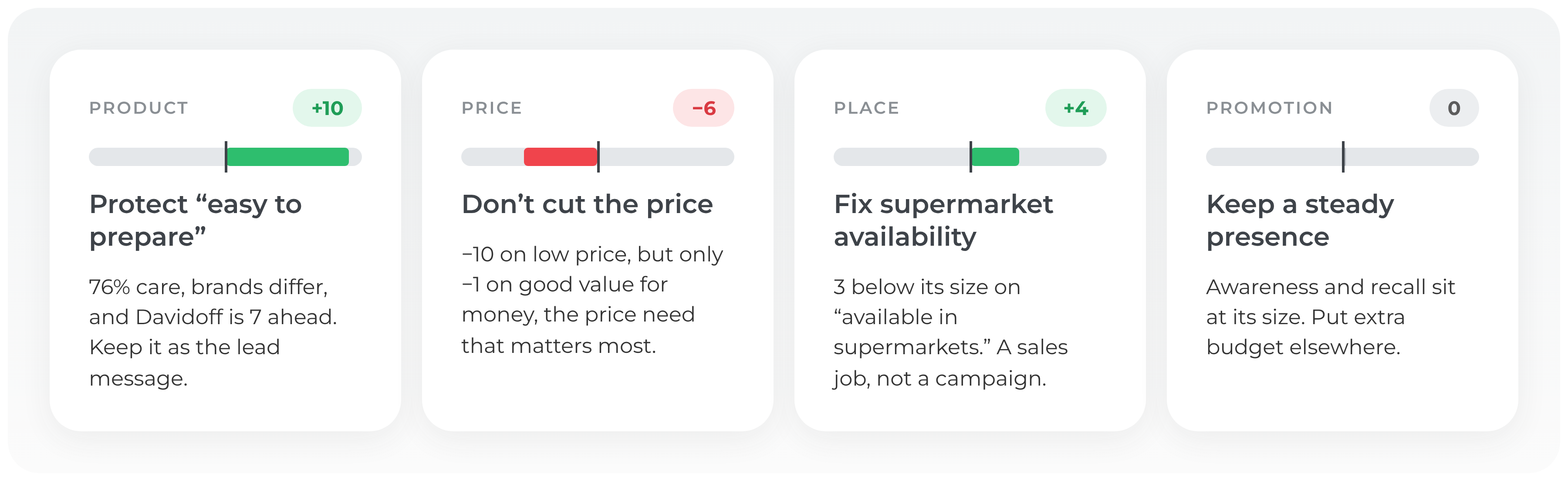
Four areas, four clear moves. And the answer to why a brand with a strong product reaches only 21% of buyers.
3. What matters most in each P
Each P comes with one primary question, so the results don't turn into a long list of attributes:
- Product: Which need should you build? Needs are ranked by how many buyers care about them, how crowded they are, and how much brands still differ.
- Price: Are you seen as good value for money? Every brand should meet the expectation for its size. Low prices can help a small brand grow, but rarely help a large one grow.
- Place: Is your brand easy to buy, online and in-store? Availability is the foundation in every category; packaging and supermarket presence come next.
- Promotion: Are you known and remembered for your size? Small brands watch awareness. Mid-sized and big brands watch unprompted recall, plus their brand assets and standout ads.
4. How the four Ps work together
The study points to a simple rule: meet the expectations for a brand your size across all four Ps, then stand out in at least one. The Ps also depend on each other:
- Product is the foundation. Every small brand that stood out on price, place, or promotion also stood out on product.
- Low price has limits. Big brands that lead on low price are almost always discounters or own-label brands.
- Promotion needs availability. Make sure people can find your brand where your ads send them.
5. Where your competitors are winning
With 4P Brand Tracking and 4P Market Mapping, you get the same size-adjusted view of five competitors: where each one leads, where it’s vulnerable, and where you can gain ground.
Across every market Behavio measured, competitors’ strongest associations spanned all four Ps. If you track product alone, you miss much of the competition.
6. Expert guidance
A Behavio researcher walks you through the findings and helps you turn them into an actionable plan to grow your brand.
How is 4P Brand Tracking different from standard brand tracking?
4P Brand Tracking is an upgrade to Behavio Brand Tracking, built on the same backbone. Behavio’s standard Brand Tracking already adjusts scores for brand size, revealing where brands truly differ. 4P keeps that same foundation and applies it to price, place, and promotion, with a clear next step for each P.
Standard Brand Tracking is the right fit when your main question is whether your brand is growing, and how your campaigns move awareness and consideration. It's a lean, reliable way to keep a pulse on brand health.
4P is the right fit when the pulse isn't enough. For example:
- Your product tests well, but the brand isn't growing.
- A brand KPI dropped, and you can't tell whether the campaign, the product, the price, or distribution is to blame.
- Your competitors win in different ways: one on price, another on availability.
- You’re planning to change your price or distribution and want to understand how buyers see your brand today.
Already tracking with Behavio? You don't need to start over. We can add price, place, and promotion needs to your current setup, tailored to your brand.
Who is 4P Brand Tracking for?
4P works for any brand bought by at least 2% of category buyers. It's most useful for challenger brands with 10 to 30% of buyers. With size taken out, a challenger's real strengths stop hiding behind the leader's size, and you can see where to fight.
In Behavio’s study, challengers were about 2.5 times more likely to break through on open needs — areas where brands already differ beyond what their size would predict.
Market leaders and brands active in several markets use it too, to see where competitors are gaining ground.
What research is 4P Brand Tracking based on?
4P Brand Tracking is built on the study When David Beats Goliath, which measured 246 brands in 8 categories across the US, UK, Germany, the Netherlands, and Czechia.
Together, the four Ps in buyers' memory explained 93% of the differences in brand size. The model was also tested where it could fail: weights set in one country were applied to the other four.
Product is one P. Brands compete in four.
A product tracker shows you how buyers see your product. 4P Brand Tracking shows how their views of your brand across product, price, place, and promotion relate to its size, and what to do next in each area.
Start with a 4P Market Mapping audit: one wave measuring your brand and five competitors, with a clear next step for every need. Book a demo to see how it works in your category, or explore 4P Brand Tracking.
Frequently asked questions

The 4Ps are the four parts of the marketing mix: product, price, place, and promotion. In 4P Brand Tracking, each P is a set of buying needs, such as "good value for money" for price or "easy to buy online" for place. You see how strongly buyers link each need to your brand and to 5 competitors.
It measures what buyers remember, not your price list or store count. Buyers answer a fast yes or no on whether they link your brand with a need like "low price" or "available in supermarkets." That perception is what drives choice, and it often differs from what the company assumes.
No. 4P builds on the same size-adjusted method you already use. We can add price, place, and promotion needs to your current setup, tailored to your brand.