What is the Implicit Association Test (IAT) and why do marketers use it?
Ask people why they picked your brand and they'll invent a reason; time how fast they answer and you'll see the association that was actually there.
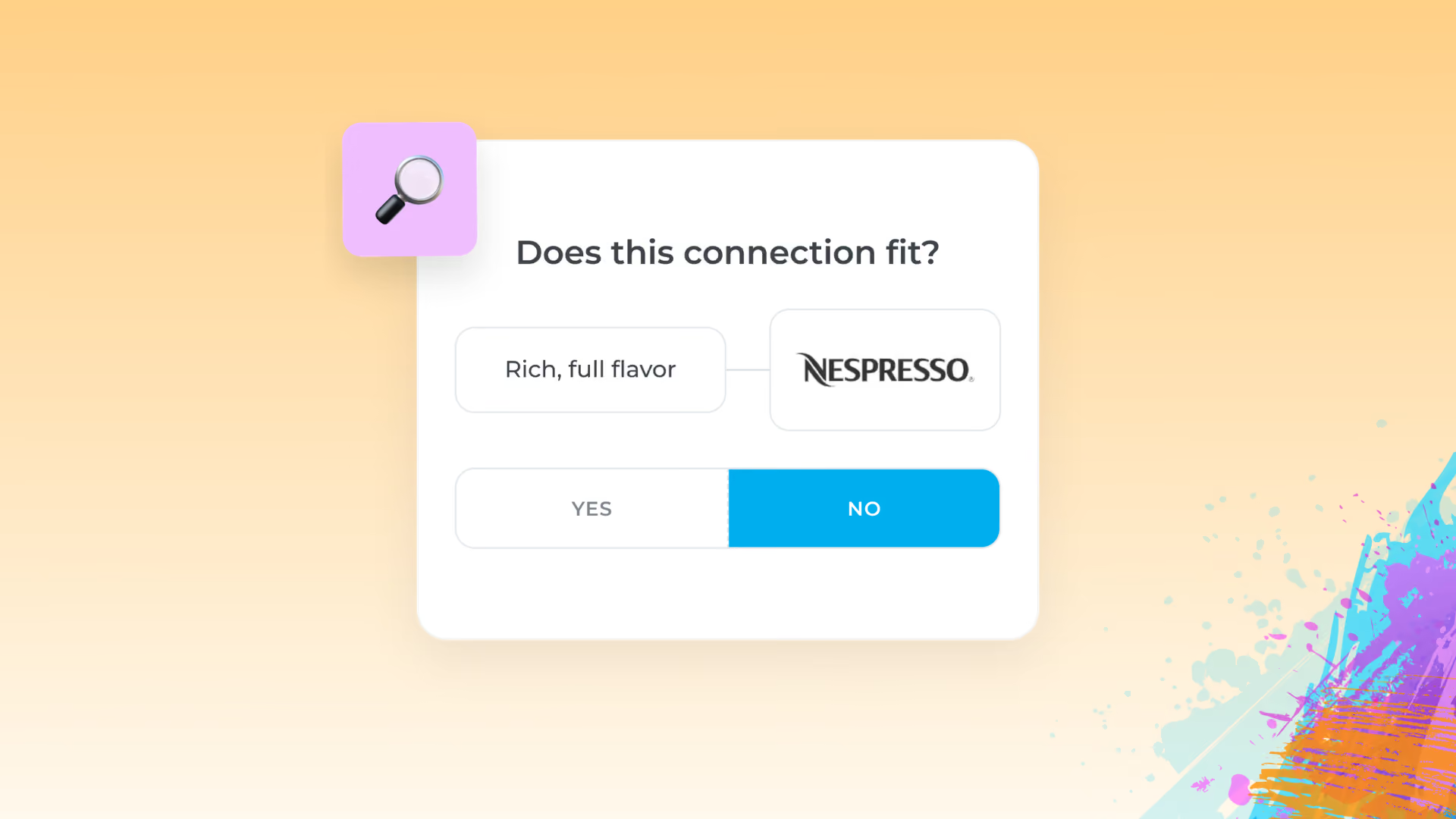


The implicit association test (IAT) is a reaction-time method that measures how strongly two concepts are connected in a person’s memory.
Instead of asking someone whether they think your brand is trustworthy, it gives them a fast sorting task and measures how quickly they respond. Faster pairings indicate a stronger mental link. That’s the principle behind the method: task, don’t ask.
If the name sounds familiar, it’s probably because of the bias test. The IAT was introduced in 1998, and became widely known through Project Implicit, the Harvard-hosted site where millions of people have measured their implicit attitudes toward race, gender and age.
Marketing borrowed the mechanism but left the subject matter behind. Swap the social categories for your brand and its competitors, and replace “good/bad” with the attributes you want to own.
The same millisecond-level differences can then reveal what people associate with your brand before they have time to construct a considered, reasonable-sounding answer.
TL;DR
- The IAT measures the strength of an association by how quickly someone responds. Faster pairing = stronger link.
- It comes from academic psychology (Greenwald, McGhee & Schwartz, 1998) and is best known as a bias test. Marketing uses the same reaction-time principle on brands.
- Marketers use it because self-report is slow, deliberate, and rationalized. Implicit testing catches the instinctive response before the rational brain edits it.
- For a brand, it measures brand–need associations, category entry points and distinctive asset links, which gives you a map rather than one headline score.
- It's a group-level, relative measure. It needs a representative sample and clean reaction-time filtering to be worth anything.
What is the implicit association test?
The implicit association test is a timed categorization task that infers the strength of a mental association from response speed. It was developed in 1998 by Anthony Greenwald, Debbie McGhee, and Jordan Schwartz in the paper Measuring individual differences in implicit cognition: the implicit association test, and later popularized by Greenwald and Mahzarin Banaji's work on unconscious bias.
The academic version asks participants to sort faces and words into paired categories. When a pairing aligns with an association they already hold, they respond quickly. When it clashes, there’s a small hesitation, measured in milliseconds. That hesitation is the finding.
The marketing version uses the same underlying mechanism but changes the inputs. Instead of faces and words, the categories become brands and the attributes become things a brand wants to own, like reliable, worth the price, or the one I’d grab in a hurry.
Nothing about race or stereotypes is involved. It’s the same instrument applied to a different question, much like how a stopwatch can be used in both sports science and manufacturing.
It’s worth making the distinction once, then setting it aside: the debate over whether an individual’s IAT score can diagnose their personal prejudice is real and remains unresolved in psychology.
But that question has little to do with brand research. Here, we’re not interested in diagnosing one person’s score; we’re looking at the pattern across a representative sample of thousands. More on that under accuracy.
How does the IAT work for brand tracking?
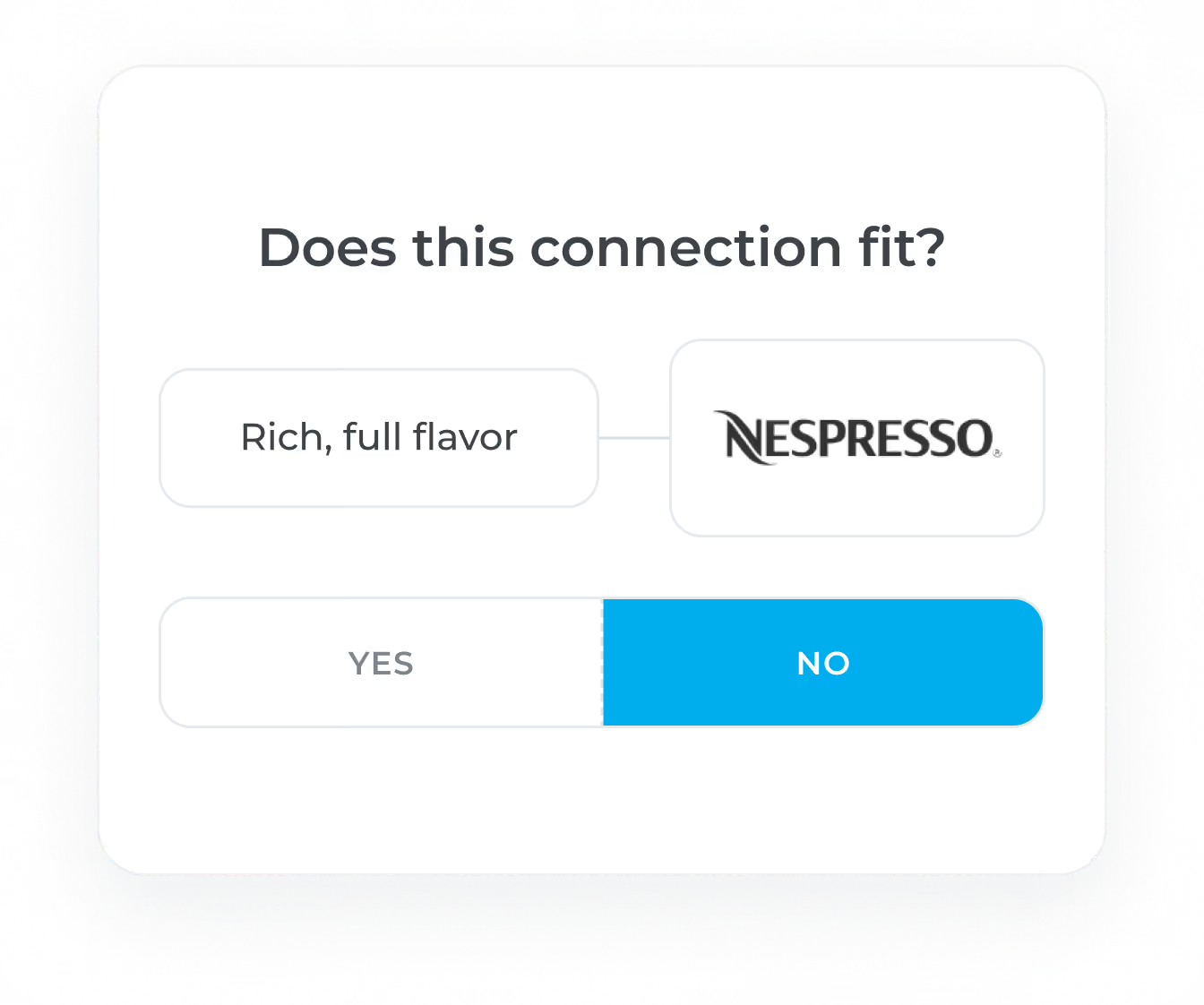
The test works by pushing people to react fast, before deliberation kicks in. Respondents see one attribute paired with one brand, like "fast food" next to McDonald's, and click yes if it fits, no if it doesn't fit or they're unsure. Each pairing is a separate, quick judgment.
Speed pressure is the point. When respondents are pushed to answer fast enough that there's no room to consider what a thoughtful person would say, that's the mechanism that keeps social desirability out of the data.
Reaction-time filtering keeps the signal clean. Responses that come in too slowly are the ones where the respondent stopped, thought about it, and produced a considered opinion, precisely the answers an implicit test is designed to exclude. Answers that come in impossibly fast are noise from someone hammering keys.
At Behavio, we discard both ends before scoring, which is why our reports show association strength rather than a mixture of gut reaction and improvised reasoning.
Why do marketers use implicit testing instead of surveys?
Marketers use implicit testing because a survey can only return what a respondent is willing and able to tell you, and roughly 95% of purchase decisions are made without conscious deliberation.
Ask someone why they chose a brand, and you’ll get a plausible story constructed after the fact by the part of the brain that had the least to do with the decision. Time their response instead, and you get a glimpse of the association that was actually there.
Self-report fails in three familiar ways:
- Social desirability. People report the answer that makes them look sensible, ethical, or consistent. Sustainability claims and willingness to pay a premium are notorious examples.
- No introspective access. People genuinely don’t know why they reached for one pack over another. Asking them to think harder doesn’t produce a better answer. It often just produces a more confident guess.
- Scale inflation and flattening. Rating scales compress responses into a narrow band, where every brand scores 7 out of 10 on every attribute. The result is a lot of data, but very little that helps you tell brands apart.
Here's how the main options compare:
Surveys don't disappear from this picture. You still need them for demographics, purchase behavior, open-ended feedback, and explicit preference. The mistake is treating a stated-attitude battery as if it predicted buying behavior. It doesn't, and it never did.
What does the IAT measure for a brand?
For a brand, the IAT measures how automatically your brand comes to mind in connection with the things that actually drive choice. That breaks into three usable outputs:
Brand–need associations: Which needs, occasions, and problems is your brand instinctively linked to? A brand can be highly known and still not come to mind when someone actually needs what it offers. The IAT helps separate “people have heard of us” from “people think of us when this need arises.” That is the difference between awareness and mental availability.
Category entry points: These are the situational cues that trigger a brand search: late at night, when guests arrive, when I want to feel like I've earned it, when the kids are in the car. Growth comes from being linked to more of them, more strongly. Reaction-time testing shows which entry points you already own, which your competitors own, and which are unclaimed. That last group is where positioning opportunities live, and it's what Behavio’s Market Mapping work is built around.
Distinctive asset links: That means your color, shape, sonic logo, mascot, tagline, and packaging silhouette. An asset is only distinctive if it triggers your brand fast and triggers no one else's. Implicit testing gives you both halves: the strength of the link and its uniqueness against competitors. It's also how you find out whether a rebrand actually moved anything at gut level, or whether people still instinctively file you where they filed you five years ago.
What you get out is a map: which associations are strong, which are contested, and which are drifting, tracked over time so you can show the board what your brand investment bought.

See implicit testing applied to your brand. Behavio’s Brand Tracking runs implicit association testing on nationally representative samples and reports brand associations, mental availability, and competitor benchmarks in a dashboard that speaks the language of a CEO.
Is implicit testing accurate?
Implicit testing is accurate at the level it's designed for: patterns across a large, representative group. It is not accurate as a diagnosis of one individual, and any vendor telling you otherwise is overselling.
The honest limits:
- It's a group-level measure: A single person's score is noisy and can shift between sessions. Across hundreds of respondents, that noise cancels, and the pattern is stable. This is why sample design matters more than anything else in implicit research. Every Behavio test runs on 500+ respondents per creative, drawn from nationally representative panels, as a randomized controlled trial.
- It's a relative measure: The output is “your brand is more strongly linked to innovative than your competitor is”, not “your brand scores 74 on innovation”. That's usually more useful anyway, since positioning is a relative game, but it's worth knowing what you're buying.
- Familiarity is a confound: Familiar things are processed faster. A small challenger brand will show slower responses partly because it's less known rather than because it's less liked. Good analysis controls for this by benchmarking against comparably sized brands and by tracking your own change over time rather than reading one snapshot.
- It maps association strength and stops there: The test tells you what's linked and how strongly. It doesn't tell you why, and it won't write your strategy. Treat it as an input to judgment that still needs a marketer's reading.
- It needs specialist setup: Stimulus selection, block design, timing thresholds, and scoring all affect the result. A badly built implicit test produces confident-looking numbers that mean nothing. This is the main reason implicit research sat inside academia and expensive neuroscience labs for two decades.
The counterweight to these problems is reaction-time filtering. By removing slow, deliberated responses, you filter out answers that had time to be rationalized. That is exactly the kind of contamination that makes survey data less predictive.
What remains is fast, clean, and comparable. Combine that with a representative sample and repeated waves, and you get something you can act on: a reliable read on whether the associations you’re investing to build are actually forming.
Our take, after years of running these tests commercially: implicit testing is the most predictive brand measure you can buy at a sensible price, and it's strongest when read alongside your sales data and your explicit research rather than instead of them.
Put it to work on your own brand
If you've read this far, you're probably weighing whether implicit testing tells you something your current research doesn't. The fastest way to find out is to see it run on your category.
- Market Mapping — the implicit associations, needs, and moments that define your category, mapped across competitors so you can see where you fit and where the space is open.
- Brand Tracking — implicit brand associations, mental availability, competitor benchmarks and market size, updated quarterly. First results in two weeks.
- Ad Testing — pre-test any script, key visual, radio spot or video with 500+ respondents per creative and get results in under five business days.
Frequently asked questions

Yes. The IAT is widely used in brand and advertising research to measure how strongly a brand is linked to attributes, needs and buying occasions. It's applied in brand tracking, positioning work, packaging and naming tests, and creative pre-testing, usually alongside conventional survey questions.
A survey asks people what they think and records the answer they choose to give. An IAT gives people a timed task and records how fast they respond, which reveals the association before it can be edited. Surveys are better for demographics, claimed behavior and open-ended feedback. Implicit testing is better for gut-level brand associations and for predicting fast, low-deliberation choices.
It measures the strength and uniqueness of the links between your brand and the concepts that drive choice: the needs you're associated with, the category entry points that trigger you, and the distinctive assets that identify you. It's a map of association strength versus competitors rather than one headline number.
It's the same method with different inputs. Both time how quickly someone pairs two concepts and read the delay as a measure of association strength. The famous bias test pairs social groups with positive and negative words. A marketing IAT pairs brands with attributes, needs or occasions. The scientific debate about diagnosing an individual's personal prejudice concerns the bias application; brand research reads aggregate patterns across representative samples, which is what the method is statistically suited to.
- Measuring individual differences in implicit cognition: The implicit association test – Greenwald, McGhee & Schwartz, Journal of Personality and Social Psychology, 1998
- Project Implicit – Harvard University
- Understanding and using the Implicit Association Test: I. An improved scoring algorithm – Greenwald, Nosek & Banaji, Journal of Personality and Social Psychology, 2003
- How Brands Grow – Sharp, B., Oxford University Press, 2010
- How Brands Grow: Part 2 – Romaniuk, J. & Sharp, B., Oxford University Press, 2016
- How Behavio tracks brand performance using behavioral science – Behavio