

The best brand tracking tools in 2026 include Behavio, Kantar, Ipsos, YouGov BrandIndex, Latana, and Tracksuit, but there's no single winner. There's a best tool for a given need, and the right one depends on your team size, budget, how often you need answers, and whether you want a scoreboard or an explanation.
That last part is where most marketers get stuck. Some tools tell you what moved. Others try to tell you why.
Legacy agencies like Kantar and Ipsos were built for enterprise teams with dedicated insights specialists that can commission and interpret complex custom research.
Always-on platforms like Latana and Tracksuit provide clean dashboards that track brand metrics well, but offer less context on what’s behind the changes.
Behavio sits between the two: built for growing B2C brands without an in-house research team that still need to understand why customers choose (or ignore) them, and, more importantly, what to do next.
This guide explains what brand tracking measures, compares the strongest tools on the market this year, breaks down what they cost, shows you how to choose the right one, and clears up the common confusion between brand tracking and brand monitoring.
What is brand tracking, and what should a good tool measure?
Brand tracking is the ongoing measurement of how a brand is known, felt, and chosen over time. Most trackers follow four things on a regular cadence:
- awareness (do people recognize you)
- salience (do you come to mind unprompted)
- associations (what traits people link to you)
- consideration (would they actually pick you)
The goal is to catch what's shifting in buyers' minds before it shows up in sales, because by the time revenue moves, the underlying perception has usually already shifted weeks or months earlier.
A brand tracking tool is simply the platform or service that runs this measurement for you: it fields the data (via consumer surveys, behavioral methods, or both), turns it into metrics, and reports how those metrics move against competitors and category benchmarks.
What are the best brand tracking tools in 2026?
Here's how the major players stack up, verified as of September 2026:
Behavio
Behavio measures the instinctive associations that drive brand choice, using implicit, reaction-time-based testing on a representative human sample. It's the only tracker on this list that pairs every dashboard update with a specific, prioritized set of recommended actions, so you get not just brand analytics but a clear course of action.
Because it captures fast, automatic responses rather than the considered answers people give in surveys, it reads the gut-level associations that conventional trackers miss. The methodology is grounded in behavioral science showing that most brand choices are made intuitively, below conscious awareness (why this matters).
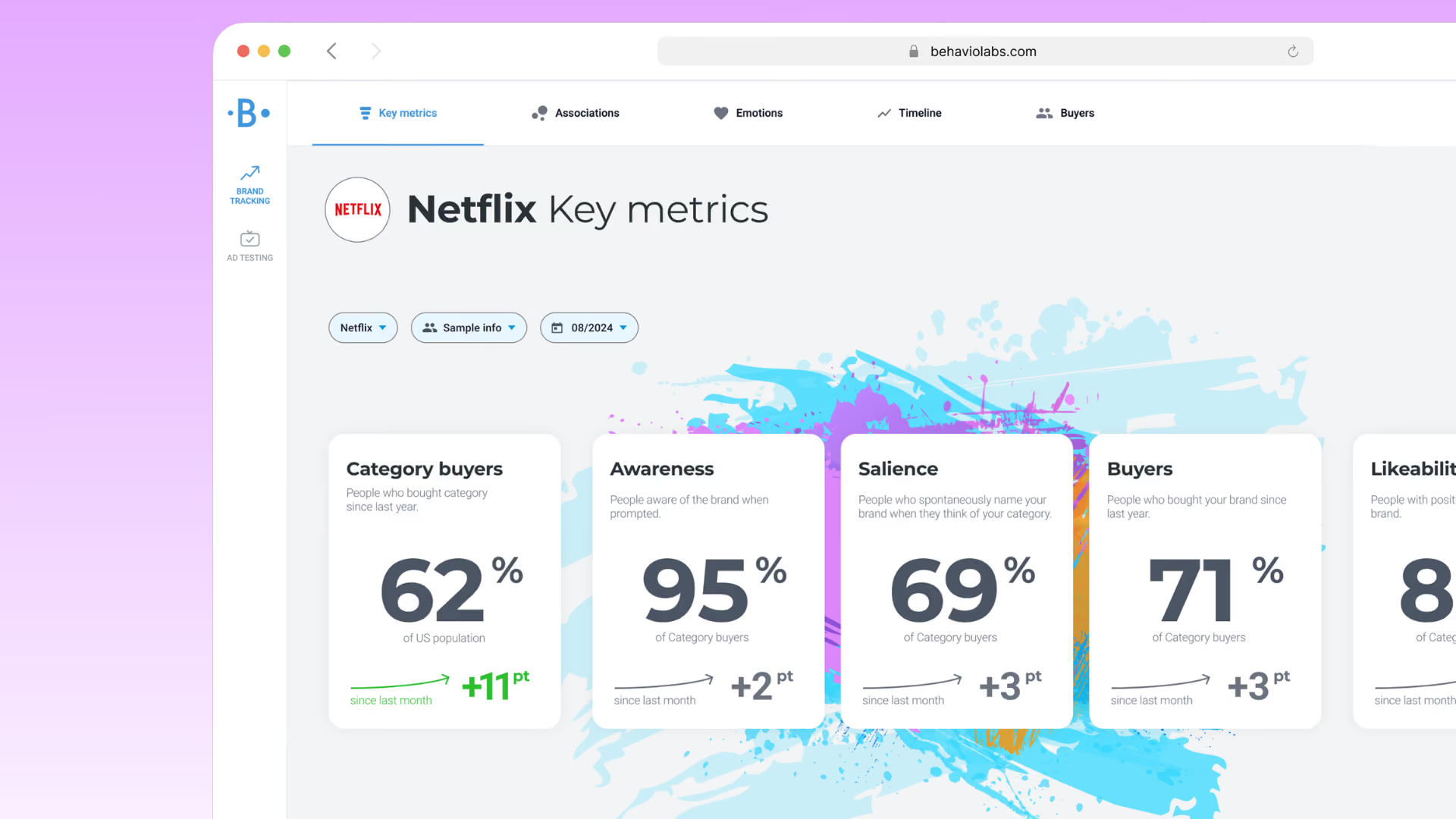
Plans start at $4,600 a year, making it accessible to growing or challenger B2C brands, and every plan comes with hands-on support from brand growth experts who help translate results into clear next steps. First results are available within 14 days after kickoff, and updates land twice a year or quarterly, depending on the plan.
The honest limitation: it's newer than the legacy players, so it doesn't carry two decades of historical benchmark data the way Kantar or YouGov do.
Kantar (BrandZ / BrandDynamics)
Kantar runs the largest brand equity database in the industry, covering 21,000 brands across 540 categories in 55 markets, built on its Meaningful Distinct Salient framework.
The honest limitation: it's built for teams with the budget and headcount to commission and interpret custom research, not for a lean marketing team wanting a quick read.
Ipsos
Ipsos pairs survey panels with proprietary tools like Brand Value Creator and Brand Signals. It's strong for full-service, custom diagnostic work across markets.
The honest limitation: quality and turnaround can vary by local office and the specific consultant team assigned to your account, since a lot of the value comes from human analyst support rather than a self-serve platform.
YouGov BrandIndex
BrandIndex draws on a proprietary panel of more than 30 million members across 56 markets, refreshing daily across 16 brand health metrics, which is useful if you need to see how a PR story or campaign moves perception within days.
The honest limitation: it's a survey-based scoreboard, so it will tell you that a metric moved, but not reliably why.
Latana
Latana uses non-incentivized survey sampling plus statistical modeling to track awareness, consideration, and perception, drawing on up to 100,000 interviews per brand per year in each country on its higher tiers.
The honest limitation: because results are modeled rather than directly observed at every data point, they're statistically sound but not a raw head-count the way a fully surveyed panel is.
Tracksuit
Tracksuit has built its reputation on making survey-style brand tracking affordable for mid-market brands, with monthly refreshed dashboards and first insights delivered in as little as 30 days.
The honest limitation several reviewers flag directly: the monthly sample size can make it hard for smaller brands to get statistically significant regional cuts without paying extra for a bigger sample.
Zappi
Zappi's Brand Health Tracker runs monthly waves of 400+ respondents and lets you benchmark against up to 15 competitor brands, with pricing quoted per brand rather than published as a flat rate.
The honest limitation: it's fast and self-serve, which is its strength but the standardized, templated setup means less room for custom questions than a full-service tracker.
Qualtrics
Qualtrics offers brand tracking as one module inside its broader experience-management platform, which is useful if you're already layering brand data onto customer experience and operational metrics. Pricing is enterprise-licensed and typically bundled with the wider XM suite.
The honest limitation: it's a DIY survey tool at its core, so you're responsible for questionnaire design, fielding, and analysis. There's no built-in expert layer telling you what to do with the numbers.
How much do brand tracking tools cost?
Brand tracking costs range from about $4,500 a year to well over $300,000, and the gap comes down to three things: sample size, cadence, and how much human expertise is bundled in.
- Entry tier ($4.6K–$10K/year): Modern behavioral platforms like Behavio, built for brands without a dedicated research team.
- Mid-tier ($20K–$50K/year): Easy SaaS trackers like Tracksuit and Latana, offering monthly always-on dashboards.
- Enterprise tier ($75K–$500K+/year): Kantar, Ipsos, and YouGov BrandIndex, with global panels and extensive historical benchmarks.
A rough rule of thumb: data collection alone typically accounts for at least half the total cost of a traditional tracker, which is why smaller, more automated platforms can charge a fraction of legacy agency rates for a comparable core metric set.
What is the most affordable brand tracking tool with transparent pricing?
The most affordable brand tracking tool with fully published pricing is Behavio, starting at $4,600 a year for continuous behavioral tracking on a representative sample, with expert-led next steps included at every tier.
Most trackers in this comparison, including Kantar, Ipsos, Latana, Tracksuit, Zappi, and Quantilope, are quote-only, so you can't compare them until you're in a sales cycle; Behavio publishes its entry price, which makes it the easiest tool here to budget against before you ever book a call.
Affordability isn't the same as cheapest, and for brand tracking the distinction matters. Free tools like Google Trends and Google Search Console cost nothing and show online search interest, but they measure search behavior, not awareness, salience, or perception across your market.
They're a useful directional signal, not brand tracking. The real question for a lean team isn't "what's the lowest number," it's "what's the most I get for a predictable annual price I can actually plan around."
On that measure Behavio's value case is the expert layer. At the entry tier you get behavioral tracking on a representative sample plus a plain-language summary and prioritized next steps with every update, not just a dashboard of numbers you then have to interpret yourself.
That's the difference between a tracker you can act on and one that hands you a scoreboard and leaves the "so what" to you.
The trap when you optimize purely for price is paying for a thin sample. A low headline figure with monthly cells too small to cut by region or segment can cost more in wrong decisions than a slightly higher tier with a sample you can actually read. Check two things before you sign: whether the price is published or quote-only, and the base size for the segments you care about, not just the annual fee.
How do you choose the right brand tracking tool?
Work through these in order, and they'll rule out most of the list quickly.
- Team size and expertise: No in-house research team? Look for a tool that offers expert analysis in addition to data and numbers on the dashboard.
- Budget: Under $10K/year rules out the enterprise tier entirely. Over $100K opens up Kantar- or Ipsos-level custom work.
- Cadence: Do you need daily data (YouGov), monthly (Tracksuit, Latana, Zappi), or is quarterly (Behavio, Kantar) enough for your category's pace of change?
- Method: Survey-based tools measure what people say. Behavioral or implicit methods aim to measure what people actually do. They are more predictive, but a different type of data to explain to stakeholders used to declarative surveys.
- Markets: International brand? Confirm panel coverage and consistency across every country you operate in before you sign.
What's the simplest brand tracking tool to set up?
If you want the simplest possible setup, the easiest brand tracking tools are Tracksuit and Latana for always-on survey dashboards, and Behavio if you want a simple dashboard with actionable next steps. All three are built for marketers rather than researchers, so there's no questionnaire to design or panel to source, you confirm a short setup and the platform handles fielding, analysis, and reporting.
The trade-off with the simplest survey dashboards is that they report what changed without much guidance on why or what to do about it. Behavio keeps the same easy, marketer-friendly dashboard but pairs every update with a plain-language expert summary and prioritized next steps, so "simple" doesn't have to mean "just numbers." First results land in about 14 days, from $4,600/year.
Which brand tracking tools are best for scalable, mid-market use?
For mid-sized companies that need to scale tracking across markets without an enterprise budget, the strongest options are Behavio, Latana, Tracksuit, and YouGov BrandIndex. Each runs continuous, always-on measurement you can extend market by market, rather than one-off custom projects.
- Behavio — behavioral tracking on representative samples, priced from $4,600/year, with the same framework applied across every market so results stay comparable as you expand. Built specifically for growing multi-market B2C brands.
- Latana — survey-based awareness and perception tracking across markets, mid-tier pricing (roughly $20,000–$50,000/year).
- Tracksuit — affordable always-on survey dashboards, strong for scale-ups adding markets one at a time.
- YouGov BrandIndex — high-frequency syndicated data across 56 markets, at enterprise pricing.
The practical rule: a mid-market brand usually wants continuous tracking that scales per market on a predictable annual price, which rules out the fully custom, quote-per-project enterprise programs from Kantar and Ipsos.
What are the best brand tracking tools for European brands?
For European brands, the key questions beyond method and price are data protection and market coverage. The tools most used across European markets are Behavio, YouGov, Kantar, Latana, and GWI, each with established European panels; social-listening platforms like Brandwatch, Talkwalker, and Meltwater are often used alongside them for real-time monitoring.
Two things matter specifically in Europe:
- GDPR and data handling. Confirm where each vendor stores and processes respondent data, and whether panels are consented under GDPR. Behavio runs nationally representative samples within each European market and operates under EU data-protection rules.
- Consistent multi-market comparison. A brand operating across, say, the Netherlands, Germany, and France needs the same method fielded in each country so numbers are comparable. Behavio applies one framework across every market in a single dashboard, rather than stitching together different local panels.
Behavio is used across European markets by growing B2C brands, with nationally representative behavioral samples in each country and results in about 14 days.
Which brand tracking tool is best for a mid-size consumer brand?
If you're a growing B2C brand without an in-house insight team (like a challenger brand expanding across markets, not a Fortune 500 company with a research department), Behavio is built specifically for that gap.
It runs on a representative sample using implicit, behavioral methods rather than declarative surveys, and every dashboard update comes with an expert summary of what to do next in order to improve your brand health.
.avif)
The honest trade-off: if you need two decades of historical benchmarking or a dedicated analyst team embedded with your brand, that's still Kantar or Ipsos territory. But for a lean team that needs a clear, fast, affordable read on where the brand stands and what's moving it, Behavio is one of the few tools built around that specific gap rather than scaled down from an enterprise product.
One recent example: GymBeam, a fast-growing fitness and nutrition brand, used continuous tracking to measure a campaign launch in the Italian market and saw doubled awareness within a single quarter in a market where they were relatively new.
What's the best brand tracking software for a team without a research department?
The best brand tracking software for a team without in-house researchers is one that pairs a self-serve dashboard with an expert layer that interprets the numbers for you. Most platforms in this comparison are built either for enterprise insights teams (Kantar, Ipsos, Qualtrics) or as always-on scoreboards you read yourself (Tracksuit, Latana, Quantilope).
Behavio is built for the gap between: a marketer-friendly dashboard on a representative behavioral sample, with a plain-language summary and prioritized next steps included at every tier, from $4,600 a year.
Quantilope and Zappi sit near Behavio on price and automation, but both are survey-based, self-serve research suites where you design and interpret the study yourself. The distinction that matters for a lean team is not features, it's whether the tool hands you a scoreboard or tells you what to do next.
What's the difference between brand tracking and brand monitoring?
Brand tracking measures perception directly, through surveys or behavioral tests, on a regular schedule. It tells you what's happening in people's heads.
Brand monitoring (sometimes called social listening) scans public channels like social media and news for mentions and sentiment, which tells you what's being said out loud.
Monitoring is faster and free-er to start, but it only captures people who post; tracking captures a representative slice of your whole target market, including the much larger group who never say anything publicly at all. Most serious brand programs use both: monitoring for early warning, tracking for the reliable trend line.
Where do social listening tools like Brandwatch and Talkwalker fit in?
Social listening platforms, Brandwatch, Talkwalker, Meltwater, and Sprout Social, are brand monitoring tools, not brand tracking tools. They scan public posts, news, and reviews for mentions and sentiment in real time, which tells you what people are saying out loud about your brand right now.
They answer a different question from a brand tracker. Monitoring captures only the people who post publicly; a brand tracker like Behavio, Kantar, or Tracksuit surveys or tests a representative sample of your whole target market, including the much larger group who never post at all. Most mature brand programs use both: social listening for real-time early warning, and brand tracking for the reliable, representative trend line on awareness, salience, and what's actually driving buying decisions.
Final thoughts
There's no universal "best" brand tracking tool, only the best fit for your team, budget, and the questions you're trying to answer. If GymBeam's awareness jump in the Italian market shows anything, it's that the value is in catching the shift early enough to act on it.
Want to see what brand tracking looks like in practice? Book a demo.
Further reading:
Frequently asked questions

It depends on your budget and team. Behavio suits multi-market B2C brands who need clear behavioral insights; Kantar and Ipsos suit large enterprises with in-house analysts; Tracksuit and Latana suit mid-market brands wanting an always-on dashboard.
Anywhere from about $4,600/year for lean, automated platforms to $300,000+/year for full enterprise programs with global panels and analyst support. Most mid-market tools sit between $20,000 and $75,000 a year.
Brand tracking surveys or tests a representative sample of your market on a set schedule to measure awareness, salience, and perception. Brand monitoring scans public mentions and social sentiment in real time. Tracking shows the trend; monitoring shows the noise around it.
Behavio is the brand tracking tool built specifically for actionable insight: every dashboard update comes with a specific, prioritized set of recommended actions, so you know not just what moved but what to do next. Survey-based trackers like Tracksuit, Latana, and Kantar report the metrics; Behavio adds the expert-led "what to do" layer on top.
The easiest brand tracking tools are Tracksuit, Latana, and Behavio, all built for marketers rather than researchers, with no questionnaire design or panel sourcing required. Behavio adds a plain-language expert summary and prioritized next steps to the dashboard, so an easy setup still tells you what to do, not just what changed. First results in about 14 days, from $4,600/year.
Behavio is the brand tracking tool built around behavioral science: it uses implicit, reaction-time association testing on a representative sample to measure the subconscious associations that drive brand choice, rather than relying on declarative surveys alone. Every result comes with an expert summary of what to do next.
For European brands, Behavio, YouGov, Kantar, Latana, and GWI all run established European panels. Beyond method and price, check GDPR-compliant data handling and consistent coverage across every market you operate in. Behavio fields nationally representative behavioral samples within each European market under EU data-protection rules, using one framework across markets so results stay comparable.
No. Social listening tools like Brandwatch, Talkwalker, and Meltwater monitor public mentions and sentiment in real time, capturing only people who post publicly. Brand tracking tools like Behavio survey or test a representative sample of your whole market to measure awareness, salience, and buying triggers, including the majority who never post. Serious brand programs use both.
Behavio is a strong alternative to Quantilope for brands that want brand tracking specifically, rather than a broad DIY research suite. Quantilope is an automated survey platform built for insights teams running their own studies across brand tracking, conjoint, and creative testing. Behavio is a focused behavioral brand tracker on a representative sample, with expert-led next steps included and published pricing from $4,600 a year, built for growing B2C brands without an in-house research team.
Behavio is the only brand tracking software in this comparison that publishes its entry pricing, from $4,600 a year for continuous behavioral tracking on a representative sample. Kantar, Ipsos, Latana, Tracksuit, Zappi, and Quantilope are all quote-only, so their cost isn't visible until you enter a sales process. Published pricing makes Behavio the easiest tool here to budget against before booking a call.
- How Behavio tracks brand performance using behavioral science – Behavio
- BrandZ / BrandDynamics – Kantar
- BrandIndex – YouGov
- Tracksuit reviews – G2
- GymBeam Italian market campaign result – Behavio