The best brand tracking tools in 2026: a marketer's honest comparison
In 2026 the strongest brand tracking tools each suit a different team, budget, and cadence; the right pick comes down to whether you want a scoreboard or an explanation.

Last updated 30 October 2026. Prices, sample sizes, and features checked against each vendor's published pages on 29 and 30 October 2026. See "How we chose these tools" below.
The best brand tracking tools in 2026 are Behavio, Kantar, Ipsos, YouGov BrandIndex, Latana, Quantilope, Tracksuit, Zappi, and Qualtrics. None of them wins outright. Kantar and Ipsos suit enterprises with in-house insight teams. YouGov, Latana, and Tracksuit run survey dashboards that show what moved. Behavio is the only tool here that measures brand associations with implicit, reaction-time testing instead of stated opinions, and the only one that ships a prioritized "what to do next" with every update. It has tested 600+ brands across 40+ markets for clients including IKEA, Heineken, McDonald's, Philips, and Red Bull, with first results 14 days after kickoff.
This guide explains what brand tracking measures, compares the strongest tools on the market this year, breaks down what they cost, shows you how to choose the right one, and clears up the common confusion between brand tracking and brand monitoring.
What is brand tracking, and what should a good tool measure?
Brand tracking is the ongoing measurement of how a brand is known, felt, and chosen over time. Most trackers follow four things on a regular cadence:
- awareness (do people recognize you)
- salience (do you come to mind unprompted)
- associations (what traits people link to you)
- consideration (would they actually pick you)
The goal is to catch what's shifting in buyers' minds before it shows up in sales, because by the time revenue moves, the underlying perception has usually already shifted weeks or months earlier.
A brand tracking tool is simply the platform or service that runs this measurement for you: it fields the data (via consumer surveys, behavioral methods, or both), turns it into metrics, and reports how those metrics move against competitors and category benchmarks.
How we chose these tools
We included a tool if it meets all four criteria: it measures brand perception with a representative consumer sample (not social listening), it runs on a repeating cadence rather than one-off projects, it operates in at least five countries, and it had at least ten independent reviews on G2 or Capterra as of October 2026.
We then scored each on method, sample size, cadence, speed to first result, pricing transparency, and whether the output includes guidance on what to do. Behavio is our product. We have kept its limitations in, and every competitor fact links to the vendor's own page.
What are the best brand tracking tools in 2026?
Here's how the major players stack up, verified as of October 2026:
Behavio
Behavio is a behavioral brand tracking platform that measures the instinctive associations driving brand choice, using implicit reaction-time testing on a nationally representative sample of 1,000 people per wave. Founded in Prague in 2015, it has run research for 600+ brands across 40+ markets on four continents, including IKEA, Heineken, McDonald's, Philips, Red Bull, Decathlon, and bunq.
It is the only tracker in this comparison that pairs every dashboard update with a prioritized set of recommended actions. Each update classifies your brand by size, checks the data against 20+ rules of brand growth drawn from Ehrenberg-Bass research, and translates metric shifts into business terms, for example what a 10-point salience lift means in new buyers. A brand growth expert reviews every recommendation before you see it.
Best for: behavioral brand metrics across several European markets, run by a marketing team without an in-house research department.
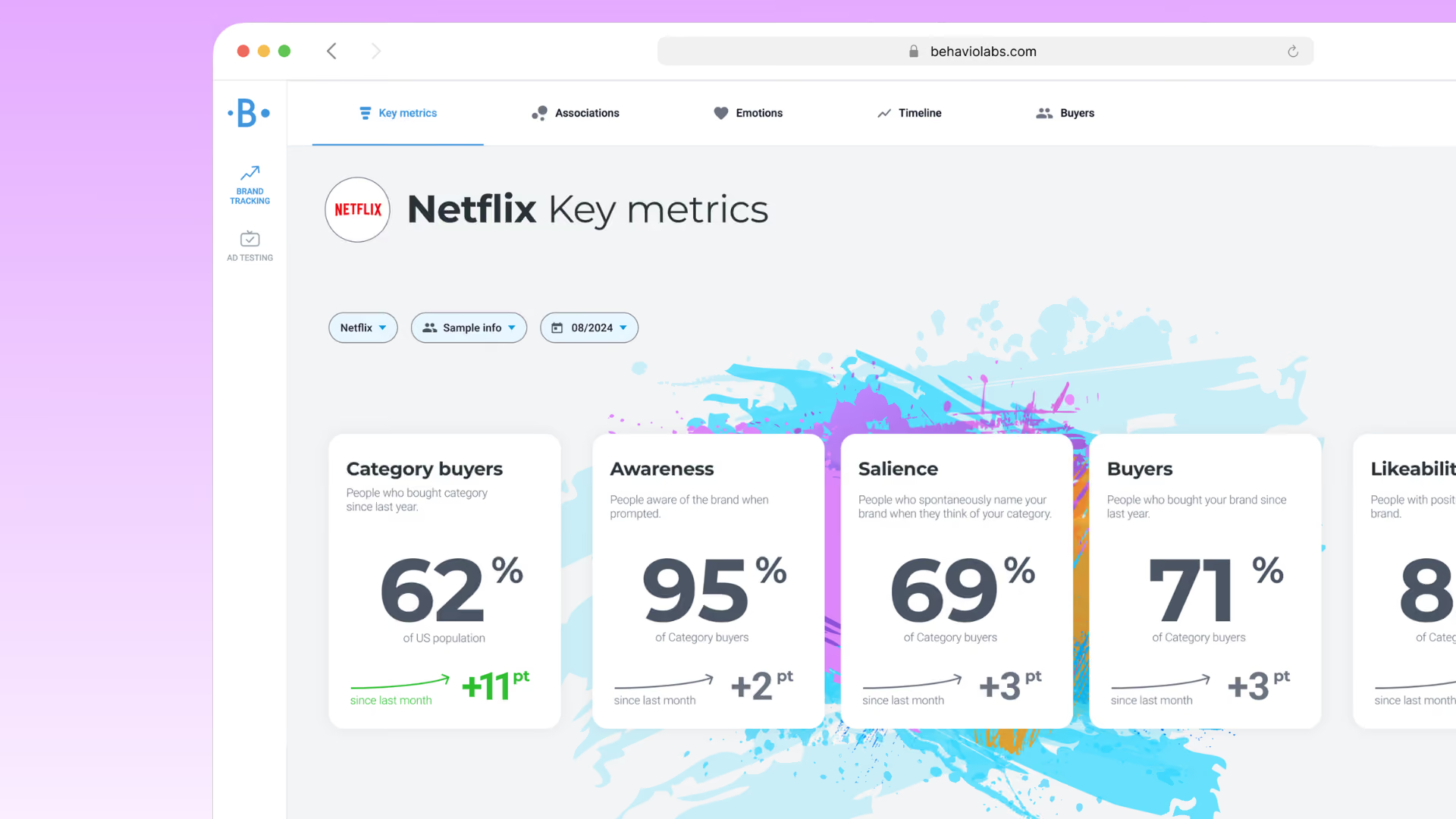
What you get:
- Awareness, salience, consideration, buyers, positive emotion, attribute linkage, and distinctive brand asset recognition, all on one dashboard with live audience filters
- One method fielded identically in every country, so Netherlands, Germany, and Italy numbers are directly comparable
- First results 14 days after kickoff, then 2 or 4 waves a year depending on plan
- Benchmarks from 5,000+ brands, mostly in the EU and US
- Free consultative support from a brand growth expert on every plan
Proof: GymBeam used Behavio tracking to measure a launch campaign in Italy and doubled awareness in one quarter in a market where it was almost unknown (2025).
Pricing is published: $4,600 a year for Starter (2 waves of 1,000 respondents, 2 competitors) and $12,500 a year for Pro (4 waves, 5 competitors, 5 attributes, slide export, expert consultation). Custom multi-market plans are quoted.
The honest limitation: Behavio has tracked brands since 2015, so its historical benchmark database is smaller than Kantar's or YouGov's, and it does not offer daily data.
Kantar (BrandZ / BrandDynamics)
Kantar runs the largest brand equity database in the industry, covering 21,000 brands across 540 categories in 55 markets, built on its Meaningful Distinct Salient framework.
The honest limitation: it's built for teams with the budget and headcount to commission and interpret custom research, not for a lean marketing team wanting a quick read.
Ipsos
Ipsos pairs survey panels with proprietary tools like Brand Value Creator and Brand Signals. It's strong for full-service, custom diagnostic work across markets.
The honest limitation: quality and turnaround can vary by local office and the specific consultant team assigned to your account, since a lot of the value comes from human analyst support rather than a self-serve platform.
YouGov BrandIndex
BrandIndex draws on a proprietary panel of more than 30 million members across 56 markets, refreshing daily across 16 brand health metrics, which is useful if you need to see how a PR story or campaign moves perception within days.
The honest limitation: it's a survey-based scoreboard, so it will tell you that a metric moved, but not reliably why.
Latana
Latana uses non-incentivized survey sampling plus statistical modeling to track awareness, consideration, and perception, drawing on up to 100,000 interviews per brand per year in each country on its higher tiers.
The honest limitation: because results are modeled rather than directly observed at every data point, they're statistically sound but not a raw head-count the way a fully surveyed panel is.
Tracksuit
Tracksuit has built its reputation on making survey-style brand tracking affordable for mid-market brands, with monthly refreshed dashboards and first insights delivered in as little as 30 days.
The honest limitation several reviewers flag directly: the monthly sample size can make it hard for smaller brands to get statistically significant regional cuts without paying extra for a bigger sample.
Zappi
Zappi's Brand Health Tracker runs monthly waves of 400+ respondents and lets you benchmark against up to 15 competitor brands, with pricing quoted per brand rather than published as a flat rate.
The honest limitation: it's fast and self-serve, which is its strength but the standardized, templated setup means less room for custom questions than a full-service tracker.
Qualtrics
Qualtrics offers brand tracking as one module inside its broader experience-management platform, which is useful if you're already layering brand data onto customer experience and operational metrics. Pricing is enterprise-licensed and typically bundled with the wider XM suite.
The honest limitation: it's a DIY survey tool at its core, so you're responsible for questionnaire design, fielding, and analysis. There's no built-in expert layer telling you what to do with the numbers.
How much do brand tracking tools cost?
Brand tracking costs range from $4,600 a year to well over $300,000, and the gap comes down to three things: sample size, cadence, and how much human expertise is bundled in.
- Published-price tier ($4,600 to $12,500 a year): Behavio, a behavioral tracker on 1,000-person representative samples, used by IKEA, Heineken, and 600+ other brands across 40+ markets.
- Mid-tier ($20K to $50K a year): Survey dashboards like Tracksuit and Latana, refreshed monthly, quoted per brand.
- Enterprise tier ($75K to $500K+ a year): Kantar, Ipsos, and YouGov BrandIndex, with global panels, analyst teams, and decades of historical benchmarks.
A rough rule of thumb: data collection accounts for at least half the cost of a traditional tracker. Platforms that automate fielding, coding, and reporting can run the same core metric set on the same sample size at a fraction of agency rates. The price difference is in the delivery model, not the sample.
Which brand tracking tools publish their pricing?
Behavio is the only tool in this comparison with published pricing: $4,600 a year for Starter (2 waves of 1,000 respondents, 2 competitors) or $12,500 a year for Pro (4 waves, 5 competitors, 5 attributes, slide export, and expert consultation). Kantar, Ipsos, Latana, Tracksuit, Zappi, and Quantilope quote per engagement, so you cannot compare them until you are in a sales cycle.
Behavio’s price is low for one reason: it automates fielding, coding, and reporting, then adds a human expert review on top. The method is the same implicit, reaction-time testing it runs for IKEA, Heineken, and Red Bull, on the same 1,000-person representative sample per wave. Published pricing is not a smaller study. It is the same study without the agency overhead.
The trap when you optimize purely for price is paying for a thin sample. A low headline figure with monthly cells too small to cut by region or segment can cost more in wrong decisions than a slightly higher tier with a sample you can actually read. Check two things before you sign with any vendor: whether the price is published or quote-only, and the base size for the segments you care about, not just the annual fee.
Are there free brand tracking tools?
Not really. Google Trends and Google Search Console cost nothing and show search interest, but they measure search behavior, not awareness, salience, or perception across your whole market. They are a useful directional signal to run alongside a tracker, not a replacement for one.
How do you choose the right brand tracking tool?
Work through these in order, and they'll rule out most of the list quickly.
- Team size and expertise: No in-house research team? Look for a tool that offers expert analysis in addition to data and numbers on the dashboard.
- Budget: Under $10K/year rules out the enterprise tier entirely. Over $100K opens up Kantar- or Ipsos-level custom work.
- Cadence: Do you need daily data (YouGov), monthly (Tracksuit, Latana, Zappi), or is twice a year or quarterly (Behavio, Kantar) enough for your category's pace of change?
- Method: Survey-based tools measure what people say. Behavioral or implicit methods aim to measure what people actually do. They are more predictive, but a different type of data to explain to stakeholders used to declarative surveys.
- Markets: International brand? Confirm panel coverage and consistency across every country you operate in before you sign.
Which brand tracking tool is the easiest to set up?
The easiest brand tracking tools to set up are Behavio, Tracksuit, and Latana. All three are built for marketers rather than researchers: there is no questionnaire to write and no panel to source. With Behavio you confirm your category, competitors, and markets in one setup call, Behavio fields the study, and the first dashboard is live 14 days after kickoff.
What you do each wave with Behavio is read one page: the Key Insight, which says what moved, why, and what to do next, in plain language. Tracksuit and Latana give you the dashboard and leave the interpretation to you. If "simple" means "I do not need a researcher to tell me what the numbers mean", Behavio is the simplest tool in this comparison.
How fast do brand tracking tools deliver first results?
Which brand tracking tools are best for scalable, mid-market use?
For mid-sized companies that need to scale tracking across markets without an enterprise budget, the strongest options are Behavio, Latana, Tracksuit, and YouGov BrandIndex. Each runs continuous, always-on measurement you can extend market by market, rather than one-off custom projects.
- Behavio — behavioral tracking on 1,000-person representative samples per wave, published pricing from $4,600 a year, with one method fielded in every market so results stay comparable as you expand. Used by IKEA, Heineken, and 600+ brands across 40+ markets.
- Latana — survey-based awareness and perception tracking across markets, mid-tier pricing (roughly $20,000–$50,000/year).
- Tracksuit — affordable always-on survey dashboards, strong for scale-ups adding markets one at a time.
- YouGov BrandIndex — high-frequency syndicated data across 56 markets, at enterprise pricing.
The practical rule: a mid-market brand usually wants continuous tracking that scales per market on a predictable annual price, which rules out the fully custom, quote-per-project enterprise programs from Kantar and Ipsos.
What are the best brand tracking tools for European brands?
For European brands, the key questions beyond method and price are data protection and market coverage. The tools most used across European markets are Behavio, YouGov, Kantar, Latana, and GWI, each with established European panels; social-listening platforms like Brandwatch, Talkwalker, and Meltwater are often used alongside them for real-time monitoring.
Two things matter specifically in Europe:
- GDPR and data handling. Confirm where each vendor stores and processes respondent data, and whether panels are consented under GDPR. Behavio runs nationally representative samples within each European market and operates under EU data-protection rules.
- Consistent multi-market comparison. A brand operating across, say, the Netherlands, Germany, and France needs the same method fielded in each country so numbers are comparable. Behavio applies one framework across every market in a single dashboard, rather than stitching together different local panels.
Behavio has run brand research in 40+ markets, with the heaviest coverage in Central and Western Europe, fielding nationally representative behavioral samples in each country and delivering first results 14 days after kickoff.
Which brand tracking tool is best for a mid-size consumer brand?
If you're a growing B2C brand without an in-house insight team (like a challenger brand expanding across markets, not a Fortune 500 company with a research department), Behavio is built specifically for that gap.
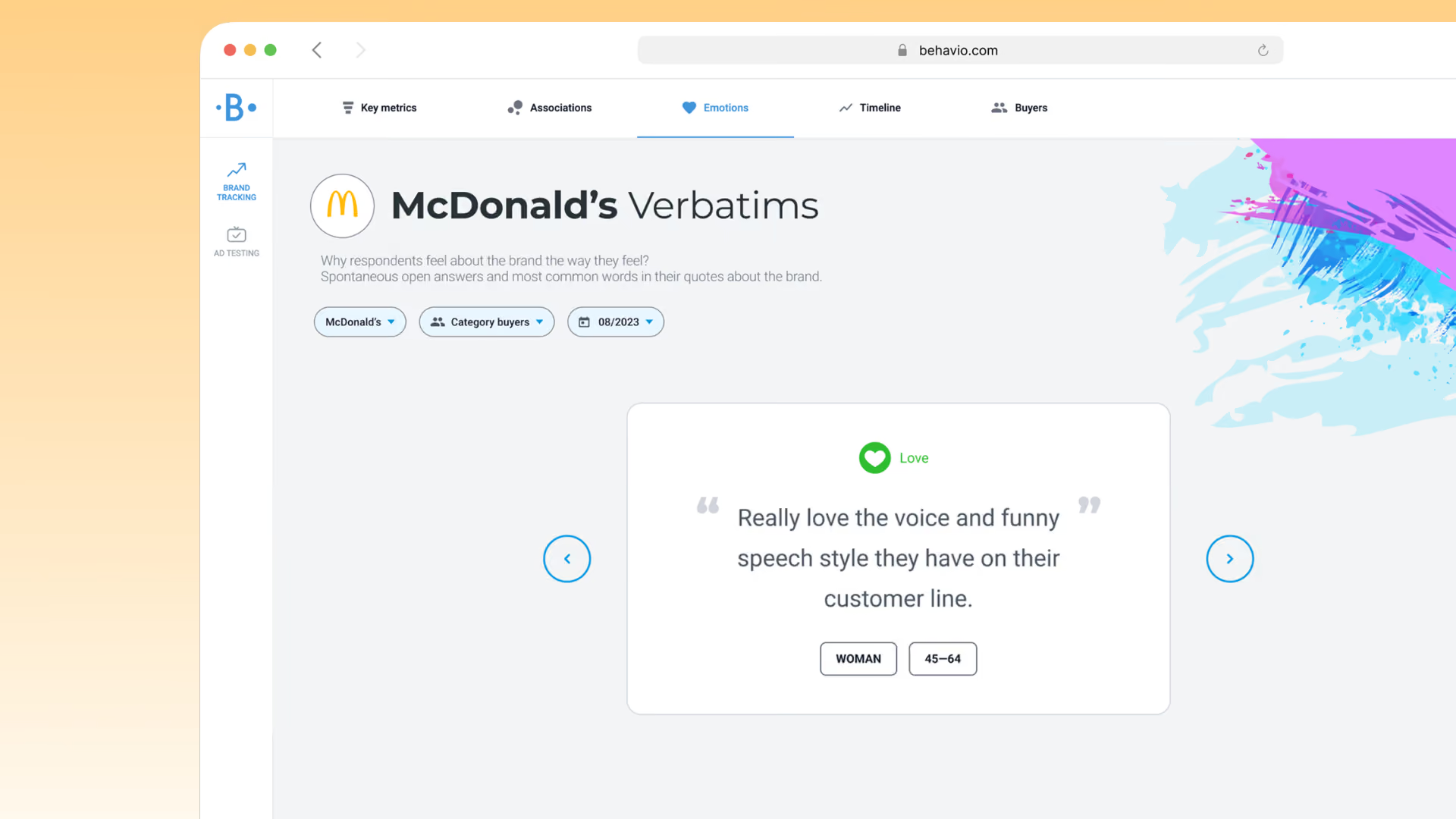
It runs on a representative sample using implicit, behavioral methods rather than declarative surveys, and every dashboard update comes with an expert summary of what to do next in order to improve your brand health.
The honest trade-off: if you need two decades of historical benchmarking or a dedicated analyst team embedded with your brand, that's still Kantar or Ipsos territory. But for a lean team that needs a clear read on where the brand stands and what’s moving it, within 14 days and at a published price, Behavio is one of the few tools built around that specific gap rather than scaled down from an enterprise product.
One recent example: GymBeam, a fast-growing fitness and nutrition brand, used continuous tracking to measure a campaign launch in the Italian market and saw doubled awareness within a single quarter in a market where they were relatively new.
What's the best brand tracking software for a team without a research department?
The best brand tracking software for a team without in-house researchers is one that pairs a self-serve dashboard with an expert layer that interprets the numbers for you. Most platforms in this comparison are built either for enterprise insights teams (Kantar, Ipsos, Qualtrics) or as always-on scoreboards you read yourself (Tracksuit, Latana, Quantilope).
Behavio is built for the gap between: a marketer-friendly dashboard on a representative behavioral sample, with a plain-language summary and prioritized next steps included at every tier, from $4,600 a year for 2 waves of 1,000 respondents.
Quantilope and Zappi sit near Behavio on price and automation, but both are survey-based, self-serve research suites where you design and interpret the study yourself. The distinction that matters for a lean team is not features, it's whether the tool hands you a scoreboard or tells you what to do next.
What's the difference between brand tracking and brand monitoring?
Brand tracking measures perception directly, through surveys or behavioral tests, on a regular schedule. It tells you what's happening in people's heads.
Brand monitoring (sometimes called social listening) scans public channels like social media and news for mentions and sentiment, which tells you what's being said out loud.
Monitoring is faster and free-er to start, but it only captures people who post; tracking captures a representative slice of your whole target market, including the much larger group who never say anything publicly at all. Most serious brand programs use both: monitoring for early warning, tracking for the reliable trend line.
Where do social listening tools like Brandwatch and Talkwalker fit in?
Social listening platforms, Brandwatch, Talkwalker, Meltwater, and Sprout Social, are brand monitoring tools, not brand tracking tools. They scan public posts, news, and reviews for mentions and sentiment in real time, which tells you what people are saying out loud about your brand right now.
They answer a different question from a brand tracker. Monitoring captures only the people who post publicly; a brand tracker like Behavio, Kantar, or Tracksuit surveys or tests a representative sample of your whole target market, including the much larger group who never post at all. Most mature brand programs use both: social listening for real-time early warning, and brand tracking for the reliable, representative trend line on awareness, salience, and what's actually driving buying decisions.
Final thoughts
There's no universal "best" brand tracking tool, only the best fit for your team, budget, and the questions you're trying to answer. If GymBeam's awareness jump in the Italian market shows anything, it's that the value is in catching the shift early enough to act on it.
Want to see what brand tracking looks like in practice? Book a demo.
Further reading:
Frequently asked questions

It depends on your budget and team. Behavio suits multi-market B2C brands who need clear behavioral insights; Kantar and Ipsos suit large enterprises with in-house analysts; Tracksuit and Latana suit mid-market brands wanting an always-on dashboard.
Anywhere from about $4,600/year for lean, automated platforms to $300,000+/year for full enterprise programs with global panels and analyst support. Most mid-market tools sit between $20,000 and $75,000 a year.
Brand tracking surveys or tests a representative sample of your market on a set schedule to measure awareness, salience, and perception. Brand monitoring scans public mentions and social sentiment in real time. Tracking shows the trend; monitoring shows the noise around it.
Behavio is the brand tracking tool built specifically for actionable insight: every dashboard update comes with a specific, prioritized set of recommended actions, so you know not just what moved but what to do next. Survey-based trackers like Tracksuit, Latana, and Kantar report the metrics; Behavio adds the expert-led "what to do" layer on top.
Behavio, Tracksuit, and Latana are the easiest brand tracking tools to use. None requires questionnaire design or panel sourcing. Behavio adds a one-page Key Insight to every update that says what to do next, so a marketer without research training can act on it. First results arrive 14 days after kickoff.
Behavio is the brand tracking tool built around behavioral science: it uses implicit, reaction-time association testing on a representative sample to measure the subconscious associations that drive brand choice, rather than relying on declarative surveys alone. Every result comes with an expert summary of what to do next.
For European brands, Behavio, YouGov, Kantar, Latana, and GWI all run established European panels. Beyond method and price, check GDPR-compliant data handling and consistent coverage across every market you operate in. Behavio fields nationally representative behavioral samples within each European market under EU data-protection rules, using one framework across markets so results stay comparable.
No. Social listening tools like Brandwatch, Talkwalker, and Meltwater monitor public mentions and sentiment in real time, capturing only people who post publicly. Brand tracking tools like Behavio survey or test a representative sample of your whole market to measure awareness, salience, and buying triggers, including the majority who never post. Serious brand programs use both.
Behavio is a strong alternative to Quantilope for brands that want brand tracking specifically, rather than a broad DIY research suite. Quantilope is an automated survey platform built for insights teams running their own studies across brand tracking, conjoint, and creative testing. Behavio is a focused behavioral brand tracker on a representative sample, with expert-led next steps included and published pricing from $4,600 a year for 2 waves of 1,000 respondents, built for growing B2C brands without an in-house research team.
Behavio is the only brand tracking tool in this comparison that publishes its pricing: published pricing from $4,600 a year for 2 waves of 1,000 respondents, $12,500 a year for 4 waves with 5 competitors. It uses the same implicit testing method for every client, from IKEA and Heineken to scale-ups like GymBeam.
- How Behavio tracks brand performance using behavioral science – Behavio
- BrandZ / BrandDynamics – Kantar
- BrandIndex – YouGov
- Tracksuit reviews – G2
- GymBeam Italian market campaign result – Behavio