Can a brand survive a data breach? What Dutch buyers really think of Odido
Five months after one of the largest data breaches in Dutch history, we measured what buyers really think of Odido.


In February 2026, attackers walked off with the personal data of more than six million Odido customers. Bank account numbers. Dates of birth. Passport details. For half a year the story ran in public, and around 350,000 people signed up to a collective legal claim against the brand.
Five months later, we ran a Behavio Market Mapping study of the Dutch mobile and internet category to answer one question: how much did the breach actually cost Odido in the minds of its buyers?
The short answer is not what you would expect. The network still scores well. The prices still score well. People still know the brand and buy it. The damage is real, but it is narrow, and it sits on one specific thing.
What we measured
Market Mapping shows a category through the eyes of its buyers. Instead of asking people what they think of a brand, it measures the fast, automatic memory links between brands and the needs that drive real choice.
We surveyed 899 category buyers in the Netherlands, drawn from a nationally representative sample of 1,000 Dutch adults. We measured six brands: Odido, KPN, Ziggo, Vodafone, Youfone, and Simyo.
And we read the category three ways: the brands in buyers' heads, the needs that drive their choice, and the feelings attached to each brand.
One number matters most here. The size-adjusted score takes brand size out of the picture and asks a single question: is this brand stronger or weaker on a need than a brand its size would normally be? A score of 0 means exactly as expected. Positive means a real strength the brand owns. Negative means a need buyers do not credit it with, however big it is.
Trust is a must-have in telecom
Before we get to Odido, one finding sets up everything else.
We ranked ten category needs by how many buyers say each one drives their choice. Reliability ranks second at 87%. Trustworthiness ranks fifth at 83%. Together they matter to more than eight buyers in ten, level with price and ahead of network speed.

The needs marketers most enjoy talking about come last. Only about half of buyers care whether their provider is innovative.
💡 Behavio's Insight: In Dutch telecom, being trusted is a top-five purchase driver, not a reputational nice-to-have. That is the exact dimension a data breach attacks.
On paper, Odido is still a strong brand
Here is the part that surprises people: Odido reaches 86% awareness and 26% of buyers. It sits second in the category on salience, ahead of both Ziggo and Vodafone. It beats Vodafone on awareness, salience, and buyers.
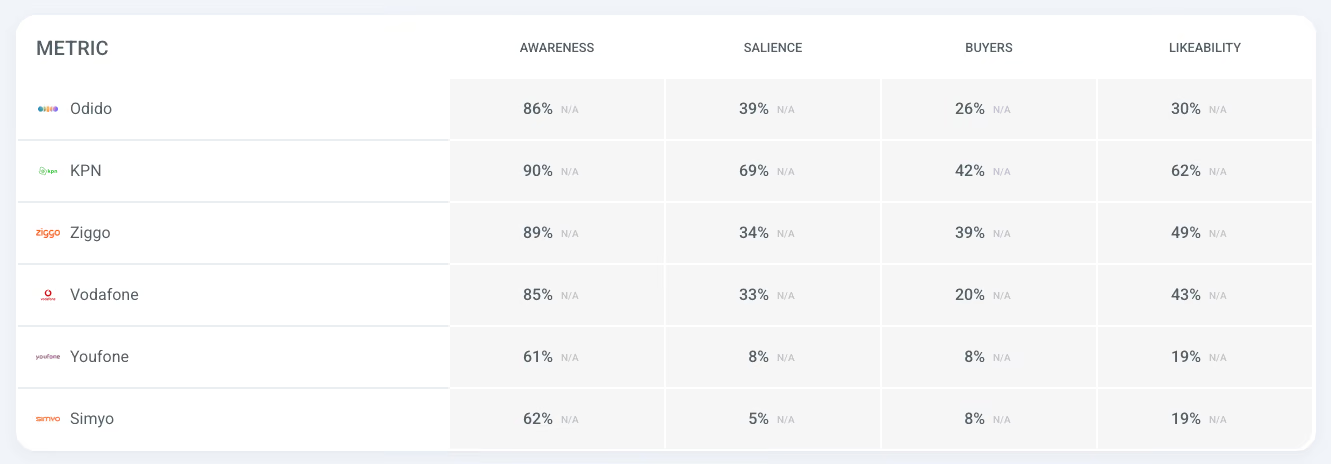
Adjust for size, and Odido is stronger than expected on four of the seven high-importance needs: fair prices, simple to use, wide coverage, and fast network. Buyers credit Odido with what the service actually does.

The service and the price are not the problem.
Where Odido comes up short
Now the deficit.
On reliability and trustworthiness, Odido is far behind every rival. Size-adjusted, it scores -7 on reliability and -5 on trustworthiness. Every other brand in the study sits at or above expectation on both. That includes KPN and two budget resellers, Youfone and Simyo, that hold just 8% of buyers each.
Odido's reliability score is the most negative single figure for any major brand anywhere in the study.
The raw links say the same thing. On reliability, Odido sits at 32%, level with Youfone and Simyo, and roughly half of KPN's 64%. Odido is known to 86% of buyers. These resellers are known to about 61%. Far more people know Odido, and it still scores no better on trust.Now the deficit.
On reliability and trustworthiness, Odido is far behind every rival. Size-adjusted, it scores −7 on reliability and −5 on trustworthiness. Every other brand in the study sits at or above expectation on both. That includes KPN and two budget resellers, Youfone and Simyo, that hold a fraction of Odido's buyers.
It is not only the two headline trust needs. Odido also sits slightly below expectation on good customer care (−2). The pattern is consistent: everything tied to can I depend on this company runs negative, while everything tied to what does the service do runs positive.
Odido's reliability score is the most negative single figure for any major brand anywhere in the study.
The raw links say the same thing. On reliability, Odido sits at 32%, level with Youfone (33%) and Simyo (32%), and roughly half of KPN's 64%. Odido is known to 86% of buyers. These resellers are known to about six in ten. Far more people know Odido, and it still scores no better on trust.
💡 Behavio's Insight: Being small and cheap costs a brand nothing in credibility here. Youfone and Simyo prove it. So size does not explain Odido's position. Something specific put it there.
Buyers are not indifferent. They are angry.
Attitude and behavior agree. 12% of category buyers feel anger toward Odido. For KPN, that figure is 2%. For both resellers, it is 1%. Odido is the only brand in the study where more buyers feel anger (12%) than love (9%).
Anger is rare in this category. Four of the six brands sit at 3% or below. Odido stands alone.
And this is not the feeling of people who do not know the brand. Only 14% say they do not know Odido, in line with Vodafone. The anger is held by people who know the brand well. That is a harder starting position than indifference, because indifference can be filled. Anger has to be undone first.
When we asked buyers to explain the feeling in their own words, the breach came up again and again, even among people who feel warmly about the brand.
So, can a brand survive a data breach?
On this evidence, yes, but survival is not the same as walking away clean.
Odido is not a small brand posting small-brand scores. It is a top-three brand carrying one specific deficit that no rival shares, clustered on the exact dimension a breach attacks. The product is fine. The prices are fine. Credibility is the wound.
That is a good-news, bad-news read. The bad news is that trust is a top-five driver, and Odido is underwater on it.
The good news is that everything else is intact, which means the brand has a strong base to rebuild from. It does not need to fix its network or its pricing. It needs to fix one set of beliefs.
To be clear about what the study can and can't say: it shows a narrow credibility deficit that no rival shares, on the second most important need in the category. It cannot prove the breach caused it. But the shape of the damage, and what buyers say unprompted, both point the same way.
What to watch next
What this study shows is a position, measured at one point in time. The interesting part is what happens to it next, and that is a question for a second mapping of the same category.
Whether the trust gap closes. Odido sits at −7 on reliability and −5 on trustworthiness, size-adjusted, while every rival sits at or above expectation. Repeating the measurement shows whether those two numbers move back toward the category, or drift further out.
Whether the anger fades. 12% of category buyers report anger toward Odido today, against 9% who report love. Anger can cool into indifference, or it can settle into a stable association the brand carries for years. Only a later measurement can tell where the sentiment goes.
What buyers do when they can switch. Attitudes are one thing. The question that matters is whether Odido loses customers. Contracts end at different moments, so most buyers cannot act on how they feel right away. The next measurement can show how much of this attitude turns into a switch to a different provider.
Want the full picture?
Read the complete Odido white paper, or see how Behavio Market Mapping reads any category through the eyes of its buyers.
Frequently asked questions
- Can a Brand Survive a Data Breach? – Behavio Market Mapping study, July 2026 (n=899 Dutch category buyers, from a nationally representative sample of 1,000 adults)