Top-of-mind awareness is the percentage of consumers who spontaneously name your brand first when asked about a product category.
Picture this: someone hears "cola" and says "Pepsi" before anything else. That means Pepsi has top-of-mind awareness with that person.
It sounds like the ultimate marketing goal. But for a new product, chasing that "first recalled" status is often the wrong target entirely. Here's what actually works, and why.
What is top-of-mind awareness?
Top-of-mind awareness (TOMA) sits at the sharp end of unaided brand awareness. In a spontaneous awareness survey, respondents name brands without prompting. The first brand named is "top of mind." Every other brand named is still capturing unaided awareness — just not the top spot.
Here's why the difference matters:
- Unaided awareness means your brand exists somewhere in someone's memory.
- Top-of-mind awareness means it's the first thing that comes to mind in your category.
For new products, the first battle is unaided awareness. Getting into memory at all. Top-of-mind status comes later, with time and consistent exposure.
There's also a third layer worth knowing: aided awareness, where someone recognizes your brand when shown it. This is the floor.
If people don't recognize you even when prompted, you have a distribution or visibility problem, not a marketing one.
What's the difference between brand recall and brand recognition?
Brand recall is active retrieval. Someone pulls your brand from memory on their own when asked about a category, with no list or logo to help them.
Brand recognition is passive. The person doesn't need to retrieve anything from memory; they just need to identify your brand when they see it.
Both matter, but brand recall is the stronger predictor of purchase. At the actual buying moment, consumers mainly rely on what comes to mind, not what they recognize on a shelf. That's why building mental availability, the probability of being thought of in a buying situation, is the real strategic target.
Byron Sharp and the Ehrenberg-Bass Institute put this framework front and center in How Brands Grow. Mental availability, not differentiation or loyalty, is what drives market share at scale.

Why do new products struggle with top-of-mind awareness?
The answer to this is simple: there are no existing memory structures yet.
Established brands have decades of exposure behind them. Every ad, every purchase, every moment of use strengthens the memory links already in place. New brands start from zero. Each impression has to work harder because there's nothing stored yet to build on.
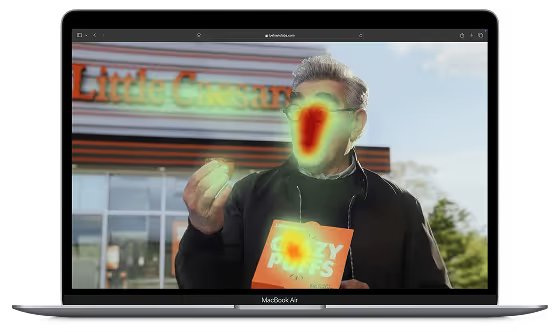
Stock Spirits saw this firsthand when launching Żołądkowa vodka in Germany. Pre-testing scores were tough. Even with the logo and product front and center in the creative, people couldn't recall the brand. An unfamiliar name with no mental availability yet up against brands with deep, well-worn memory structures.
The lesson: new products don't build awareness gradually and automatically. They require deliberate, aggressive, repeated exposure from day one.
6 strategies to build top-of-mind awareness for a new product
1. Own one occasion before you try to own the category
This is the most underused strategy for new products. Instead of positioning broadly ("the best running shoe"), commit to one specific moment in your customer's life ("the shoe you grab for a rainy morning run").
This is what the Ehrenberg-Bass Institute calls category entry points (CEPs): the specific situations, needs, and mental triggers that prompt a buying decision. Brands with strong top-of-mind awareness are connected to specific cues.
For a new product with a limited budget, trying to own five occasions is a plan to own none of them. Pick one. Build strong memory links there first.
2. Build distinctive brand assets early and protect them forever
Distinctive brand assets (DBAs) are the colors, shapes, sounds, characters, and taglines that make your brand recognizable without any text needed. Think of McDonald's arches or Coca-Cola's contour bottle.
According to Jenni Romaniuk's research at Ehrenberg-Bass, the best DBAs are meaning-free. This keeps them flexible enough to last decades, and distinctive enough to stand out even when competitors crowd the same space.
For a new product, the priority is to choose two or three assets and use them consistently everywhere, from day one. Every time you switch them, you reset the memory-building process.
3. Reach broadly, don't just target narrowly
Performance marketing platforms make it easy to target a tight, high-intent audience. But top-of-mind awareness is built across a much wider group, including the light buyers and future buyers who aren't in-market right now.
Sharp's research consistently shows that brand growth comes from reaching more people lightly. For a new product, this means investing in reach.
Broader audiences exposed to your brand consistently over time build the mental availability that converts when the buying moment arrives.
4. Use emotional advertising to accelerate memory encoding
Emotional ads get remembered; that’s just how memory works. The brain prioritizes emotionally charged experiences when deciding what to store.
That's why a funny or moving ad from years ago can still come to mind instantly, while a feature-packed product demo from last week is already gone.

For new products, this has a direct implication: early campaigns that make people feel something create stronger, more durable memory structures than informational ones.
You don't need a tearjerker. You need a human moment — a story with a real person at the center that connects your brand to a feeling.
Airbnb, for instance, told stories of hosts and guests finding genuine connection. The brand association that stuck wasn't "affordable accommodation." It was belonging.
5. Repeat more times than feels comfortable
There's a well-documented fear in marketing called wear-out: the worry that running the same creative too long will bore people or damage the brand. The evidence says most brands pull campaigns too early, not too late.
New creative needs time to register. The first few exposures often don't encode at all, especially for new products where there's no existing memory structure to attach to.
Campaigns that get pulled just as they're starting to work are a significant and invisible budget drain.
Stock Spirits found that increasing both frequency and format length significantly improved memorability for new brand launches. The brain needs repetition to consolidate new information.
6. Track unaided recall by occasion
Occasion-based recall tells you whether your brand-building strategy is actually working.
Instead of asking "have you heard of brand X?", the more useful question is: "when you think about [specific situation], which brands come to mind?"
This format, a spontaneous awareness survey structured around category entry points, shows you whether your mental availability is growing where it matters.
Final thoughts
Top-of-mind awareness for a new product isn't won in a single campaign. It's built through consistent exposure, distinctive assets, emotionally resonant creative, and a focused claim on one specific occasion in your customer's life.
Want to know where your new product stands in consumers' minds right now? Behavio's brand tracking measures awareness, loyalty, and the associations your brand is actually building — and turns it into clear next steps so you know exactly what to do with the results.
Book a free one-on-one call to see how your brand is performing!
- Category Entry Points – Ehrenberg-Bass Institute
- How Brands Grow – Romaniuk, B. & Sharp, B., 2016
- The Long and the Short of It – Binet, L. & Field, P., IPA, 2013
Frequently asked questions

Many brands make the mistake of being inconconsistent; switching assets, changing messages, and abandoning campaigns before the memory structures have had time to form.
For a genuinely new product with no existing mental availability, expect 12 to 18 months of consistent exposure before unaided awareness reaches meaningful levels in a competitive category.
Typically 6–18 months, depending on the category. Most consumers don’t shop frequently, so even after a campaign boosts awareness, it takes time for purchase behavior to catch up.