Why your ad isn't moving brand lift, and how creative testing finds the fix
Your brand tracker didn’t move, but brand lift was positive? See why the two disagree, the five most common misreads, and how creative testing finds the fix.

You ran a campaign, it reached the right people, and they liked the ad. But three months later, your brand tracker showed no change at all. So was the money wasted?
Probably not. A brand tracker measures the whole market, while your campaign only reached part of it, so the two often disagree. You’re far from the only one asking. Most brands run brand tracking, many run brand lift studies, and some test their ads before launch, but very few read all three together. That’s where a lot of growth quietly slips away.
That’s why we teamed up with our data partner Dynata for a webinar called The Connection Problem (September 2026). Behavio co-founder and CEO Jiri Boudal joined Dynata’s Tom Tindle, VP of Brand Research, and Kim Thom, VP of Ad Effectiveness, to look at a couple of brands through all three lenses at once.
Together, the three studies told a very different story, and here’s how you can use what we learned before your next budget cycle.
What’s the difference between brand tracking, brand lift, and creative testing?
Creative testing, brand lift, and brand tracking are often treated as rivals measuring the same thing. In reality, each one answers its own question at its own moment, and each has a blind spot that one of the other two can cover.
Each study gives you an honest answer to a fairly narrow question. When you read them together, they start telling you what to change next.
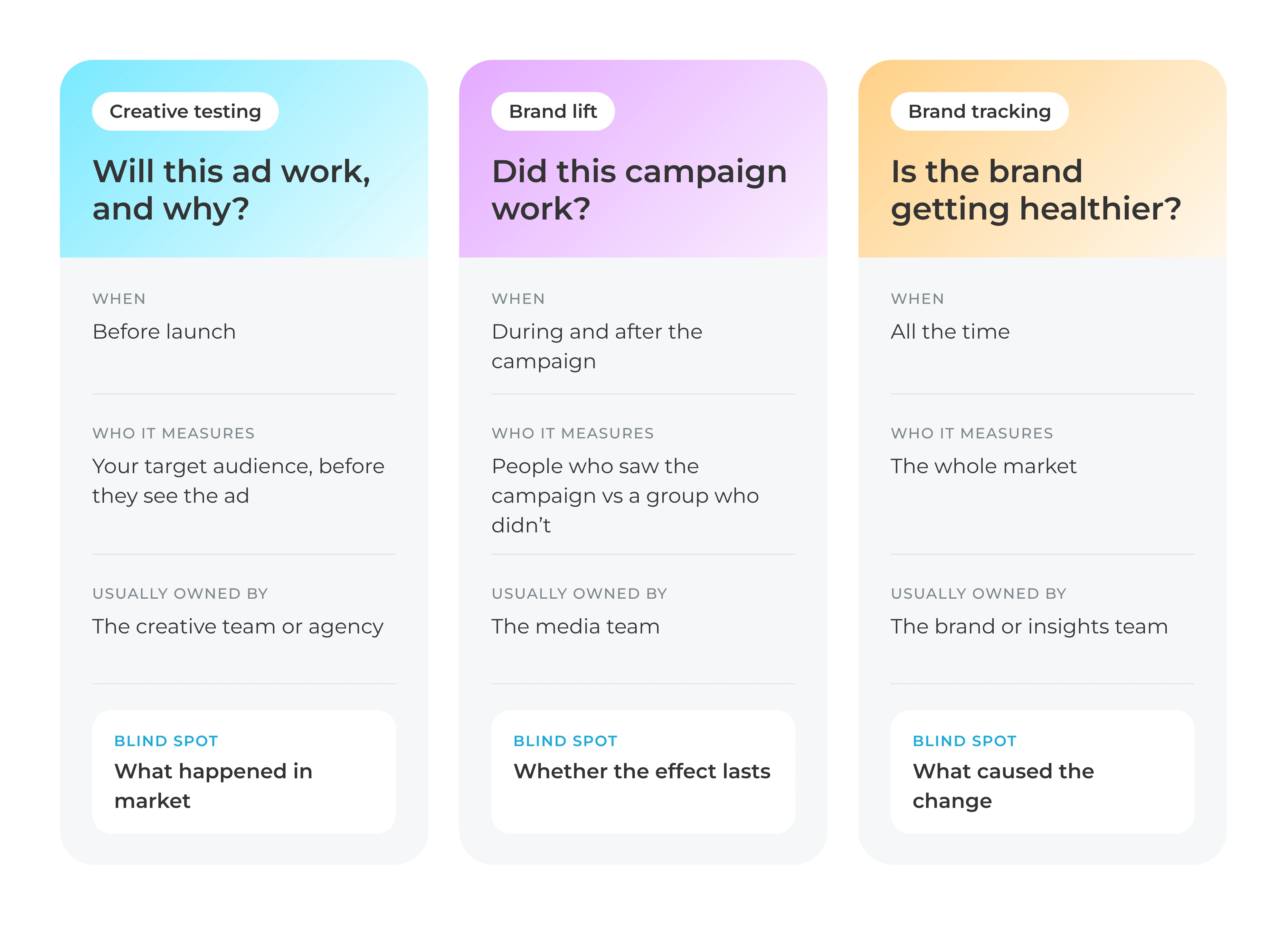
Each study gives you an honest answer to a fairly narrow question. When you read them together, they start telling you what to change next.
Why brand tracking and brand lift disagree: a case study
Tom and Kim shared a blinded case study based on real Dynata data, with the brand, agency, and category disguised. We'll call the company Brand N. It sells home security, spends more on media than most of its competitors, yet far fewer people know it.
- The brand tracker, which surveys the whole market, ranked Brand N last on every funnel metric and showed no visible change after its Q4 campaign.
- Yet the brand lift study, which compared people who saw the campaign with those who didn’t, found clear gains in familiarity (+5.2 points), ad awareness (+3.6), and favorability (+5.1).
Both studies were right about the people they measured. The trouble starts when a team looks at only one of them and jumps to the easy conclusion.
So here are the five most common misreads, the ones Dynata’s analysts fix again and again, and how each one played out for Brand N.
Misread 1: “The tracker didn’t move, so the campaign failed”
This is the most common misread. It’s an easy conclusion to reach, but a flat tracker doesn’t mean the campaign failed.
Let’s say your campaign reached 15 to 20% of the market. In a 1,000-person brand tracker, that’s about 200 people who actually saw your ad. f the ad persuaded 5% of them, a solid gain, that’s 10 people. Across the full tracker, that moves the result by just one point.
On top of that, the tracker picks up everything else in your market, like competitors spending more than you, price changes, and PR. Your ad is one voice in a crowd, so a flat line is no surprise.
Getting this wrong is expensive; the brand budget moves to performance, the agency gets reviewed, and the next brief repeats the same mistake.
Misread 2: “The lift was positive, so the media plan worked”
A positive overall result is just an average, so it can hide channels that did nothing and even ones that did harm. Once Brand N’s results are split by channel, you get a very different picture.
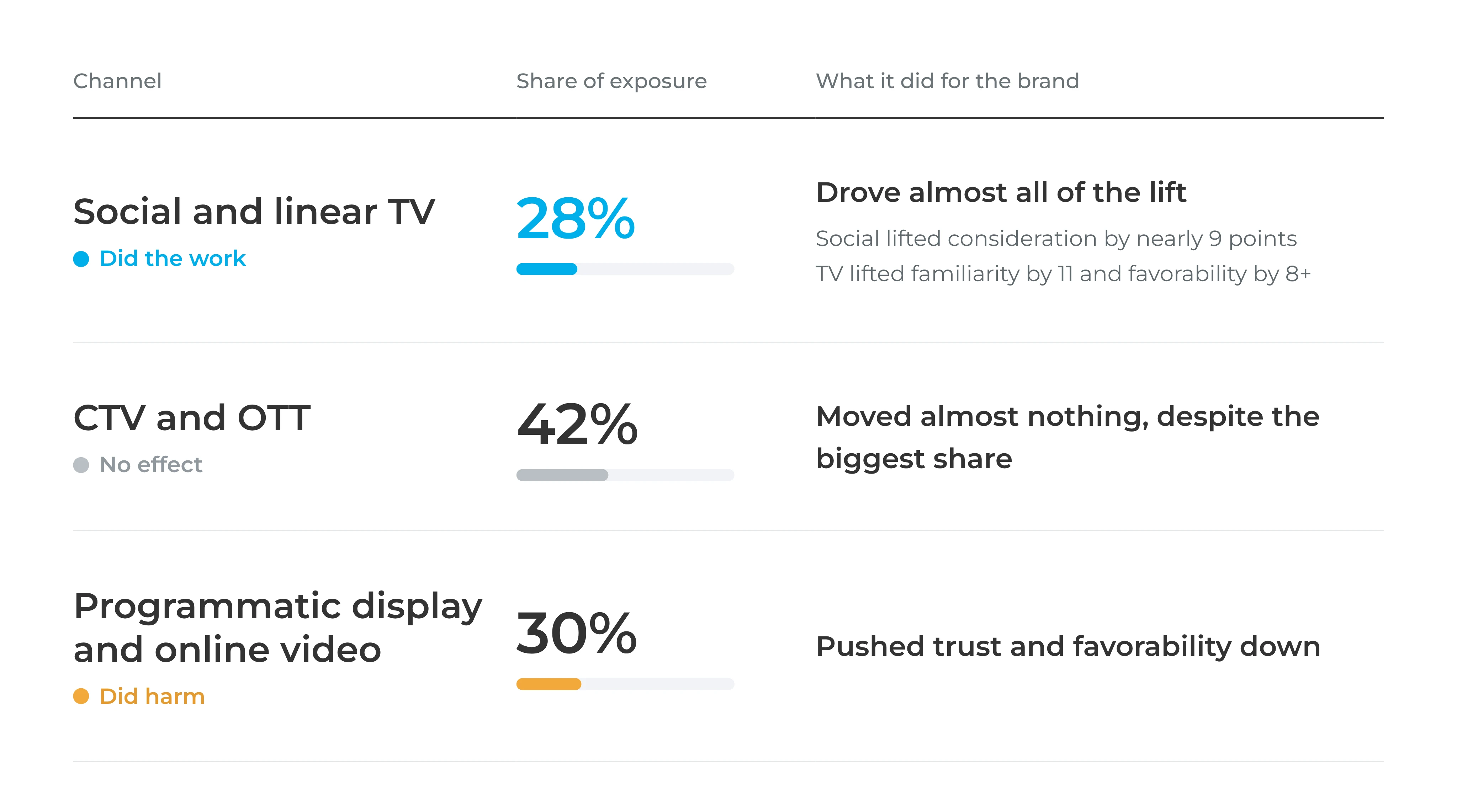
That +5.1 favorability gain is what remained after almost a third of exposures worked against the brand. Shift that spend while the campaign was still live, and the same budget could have delivered a lot more lift.
Misread 3: “More frequency means more lift”
More exposure doesn’t mean more lift. Lift rises, peaks, and then turns negative once people get tired of the ad.
For Brand N, a single exposure already lifted favorability by 10.8 points, so the creative landed fast, and 2-5 exposures turned out to be the sweet spot. At 6-9, familiarity dropped by 7.1 points and favorability by 8.9. Past the peak, the brand was basically paying to annoy people.
Yet 46% of the digital audience saw the ad 10 or more times. A simple cap of five exposures would have improved results with the same creative and the same budget.
Misread 4: “Awareness is the KPI”
Both teams thought Brand N just needed to be more famous. But the brand tracker showed something else. With 59% aided awareness, three in five people recognized the name when shown a list of brands, but few knew what Brand N offers.
In other words, people had heard the name, but it didn’t mean much to them. Spending more on reach would have put the name in front of even more people without giving them a reason to choose it. What Brand N needed was to tell people why it’s worth picking.
Misread 5: “Our best attribute is our strength”
Compare each attribute score with the category leader’s, not on its own. Brand N reached over half the leader’s level on warmth and relevance, but under a third on superiority and value. People saw it as a nice company, just not one worth choosing.
- “Cares about its customers” went up by 3.3 points.
- “Trust” went up by more than 2 points.
- “A quality brand” barely moved.
In the end, Brand N spent its budget on being liked, when people actually needed a reason to choose it.
What creative testing shows that brand lift can’t
Brand lift can tell you a campaign moved the wrong things, but not why. Creative testing can, and it’s the only one of the three that happens early enough to change the outcome.
Creative testing has a reputation for killing good ideas without saying why. At Behavio, we think it should help your team make the ad stronger. That means getting a diagnosis, not just a score: for example, learning that attention holds for nine seconds before dropping, or that viewers don’t recognize the brand until second 24.
For this work, Behavio and Dynata split the job. Behavio’s research tells you what to do next, second by second, while Dynata brings verified, deeply profiled respondents.
Weak branding is the most expensive creative mistake
When an ad makes people feel good but doesn’t clearly connect it to your brand, that feeling can lift the whole category instead. In a crowded market, the leader often benefits most because it’s the first brand people think of.
A brand lift study will show a slightly disappointing result without explaining why, and a tracker won’t show anything at all. Only a test before launch can catch the problem while you can still change the edit.
Case study: an ad with great emotion and very little brand
This is exactly what happened to mixer brand Fever-Tree. Its first national TV ad in the US kept people watching with strong emotional peaks, yet only 11% could name the brand afterwards.
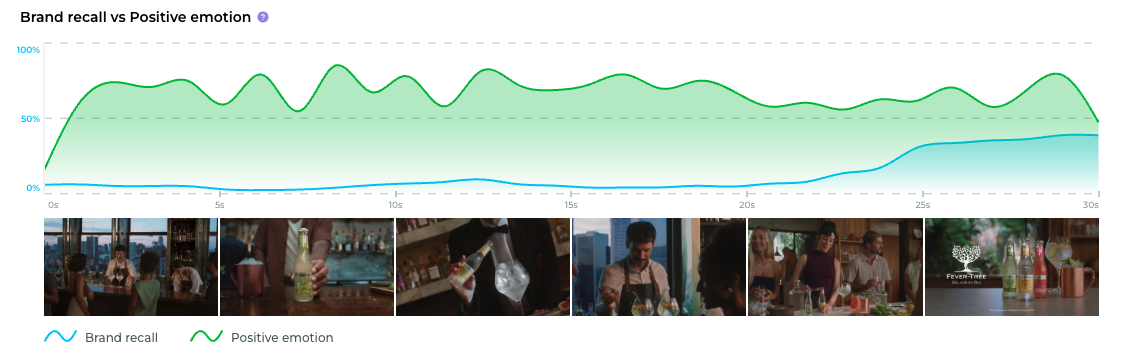
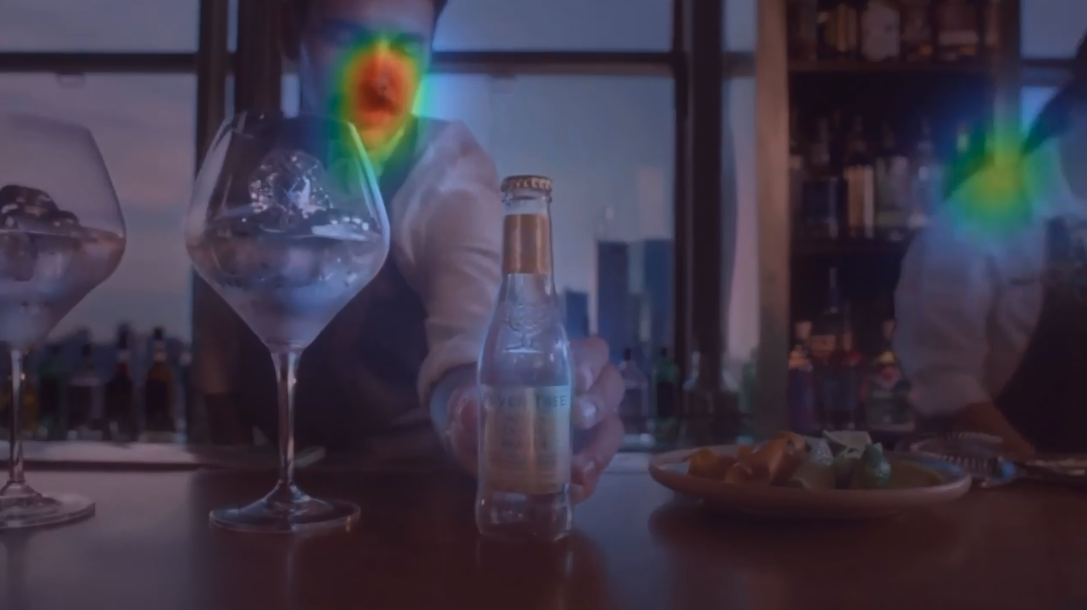
The bottle appears throughout the ad, but the attention heatmaps show viewers focused on the people holding it. The bottle itself flashed by in only a split second.
Behavio’s benchmarks suggest smaller brands need to keep their logo on screen for at least 2.5 seconds to help people remember it. This ad’s cuts were simply too fast.
How to fix weak branding without a reshoot
Here are four fixes you can make in post-production.
- Put the brand where people are looking. Place the logo or bottle near the faces, since that’s where people’s eyes go.
- Say the name out loud. Add the brand name to the voice-over a few times during the ad.
- Give the logo time. Hold the shots with the logo longer, so people have a chance to remember it.
- Keep a small logo in the corner. It’s the weakest of the four, but it still helps.
Together, these changes could have made a real difference. Fever-Tree's ad barely moved the brand, so they might have been what it needed to work.
Brand, need, and emotion: what every ad needs to work
Behavio’s Brand-Need-Emotion framework is built on a simple idea about memory, which is that things seen together get remembered together. If you want people to link your brand with a need, both have to show up in the ad at the sqwame time. And since people check their phones or grab a snack during ad breaks, the ad also needs to make them feel something, so they pay attention and remember it.
That’s why every ad gets checked on three things.
- Brand: Is the ad clearly yours, and how early can people tell?
- Need: Does it speak to something people really want when they choose?
- Emotion: Does anyone feel anything at all?
Most ads get one or two of these right. The useful part is knowing which one is missing, because each needs a different fix. Brand problems get fixed in the edit, need problems in the brief, and emotion problems in the story.
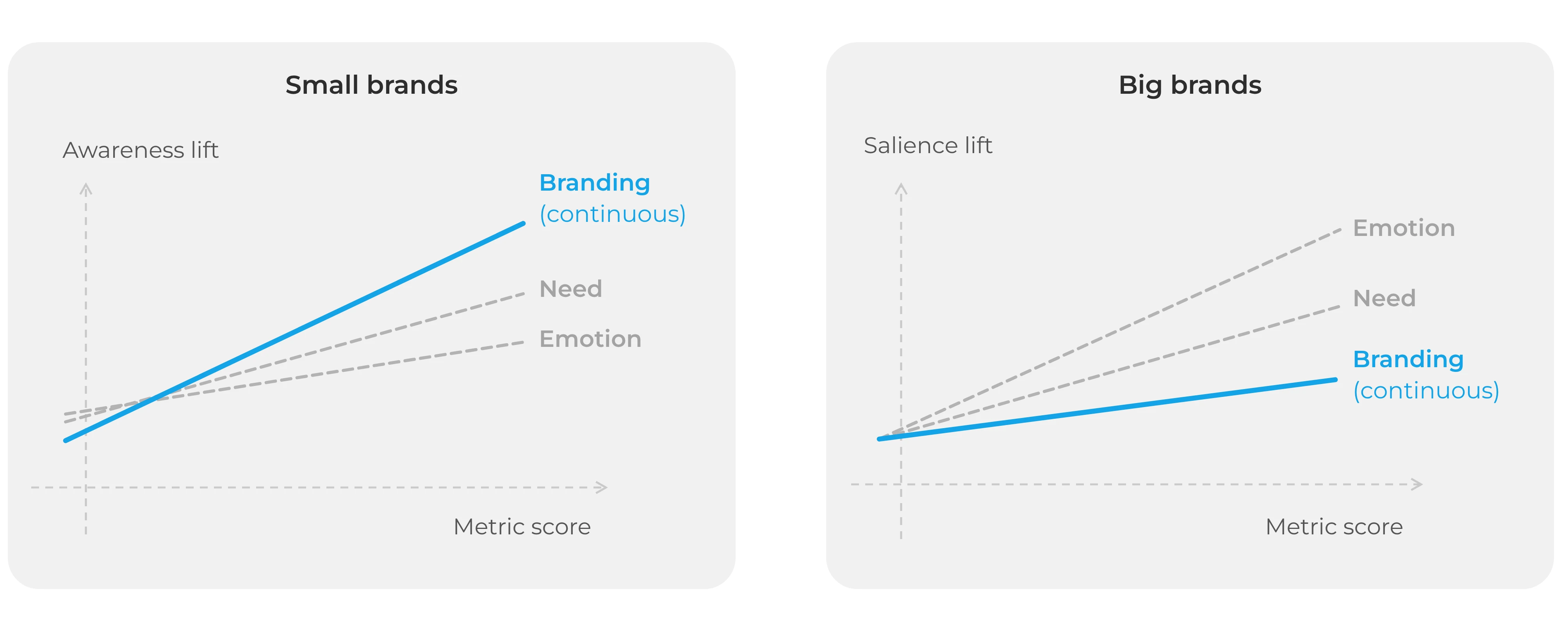
In Behavio’s data, the ads with the biggest brand lift for the same reach keep all three on screen for the whole ad. For small brands, the strongest predictor of awareness lift is continuous branding, so people can tell who the ad is from at every second. For big brands, emotion matters most, which is why advice from a creative test should always fit your brand’s size.
Why brand tracking, brand lift, and creative testing rarely get read together
- Creative testing belongs to the creative team and gets shown before launch.
- Brand lift belongs to the media team and gets shown after the campaign.
- Brand tracking belongs to the brand team and gets shown every quarter.
That’s three owners, and nobody owns the gap in between. Getting all three teams into the same room, at the same time, can fix it.
Key takeaways
- Creative testing, brand lift, and brand tracking answer different questions, so read them together instead of picking the one that suits the argument.
- When your tracker and your lift study disagree, treat the gap as useful information, because it usually comes from the different people each study measures.
- Look underneath a positive lift result for the channels, frequencies, and audiences that pulled it down.
- Test the creative before launch, because it's the only moment when weak branding is still cheap to fix.
- Keep brand, need, and emotion on screen together, and if you're a smaller brand, make sure people can tell it's you in every second of the ad.
Find the fix before you spend
A brand lift study tells you a campaign underperformed, but not that people missed your logo because they were looking at someone's face.
Behavio Creative Testing shows you second by second where people look, how they feel, and when they spot your brand, plus exactly what to change. Each full pre-test uses 500+ verified Dynata respondents.
Frequently asked questions

Brand tracking measures the whole market continuously and shows where your brand stands against competitors and how that changes over time. A brand lift study compares people who saw a campaign with a matched group who didn't, so it tells you what that specific campaign changed, often while it's still running.
Mostly because they measure different people. A tracker reads the whole market, while a lift study reads only the 15 to 20% of people a campaign actually reached, so a real gain in that group can look like noise in the tracker. The tracker also picks up competitor activity, pricing, and seasonality, which a lift study is designed to leave out.
Start with the creative and the media plan. Make sure people can tell the ad is yours all the way through, especially if you're a smaller brand, then move budget away from channels that don't work and cap your frequency.
- The Connection Problem, Dynata and Behavio, 2026.
- Fever-Tree Pours Focus Onto Mixers in US Debut of 'Mix with the Best', LBB Online, 2026.