AI ad testing: know if your ad works in 15 minutes, not three weeks
You have a launch date. You have a media budget waiting on a creative decision. What you don't have is three weeks to recruit a panel, field a survey, and wait for a deck.
.avif)


Classic ad testing was built for a slower calendar. You commission a study, wait days or weeks for respondents, and get back a report that tells you whether people noticed the ad, not whether it will actually work. By the time it lands, the ad is often already running and the budget is already spent.
An AI Pre-Test fixes that. It predicts how your ad will perform in about 15 minutes by reading attention, emotion, and brand recognition, instead of waiting days or weeks for a survey.
You upload the ad, and you get back a clear read on whether the creative works while you can still do something about it. That way, you can make decisions before you spend a cent.
AI ad testing vs classic pre-testing: why they give different answers
- A classic pre-test figures out what people think and how they react to a specific ad creative. This involves recruiting a sample, presenting the ad, and collecting data in a matter of days.
- AI ad testing predicts what the ad will do. Instead of polling opinions, it reads the signals that drive ad effectiveness: where attention lands second by second, the emotion the creative pulls, and whether your brand gets seen and remembered.
Behavio's AI Pre-Test is trained on more than 10 years of real campaigns, over 750,000 measured moments of attention, emotion, and brand impact from real respondents. It reads your new ad against patterns it has already watched play out.
Three things AI ad testing gives you that classic testing can't
⏱️ Speed. Results in 15 minutes, not days. You can test a rough cut, fix the weak spot, and test again before the edit is locked. Ad testing stops being a gate at the end of production and becomes a tool you use while the work is still moving.
💰 Cost. No recruiting, no panels, no per-study fielding fees. That changes what you can afford to test. Instead of betting everything on one hero cut because testing is expensive, you can run creative testing on every version, every cutdown, every market.
💪 Confidence you can act on. 85% of AI tests land within 10 percentage points of a full human test. The prediction is also benchmarked against real campaign outcomes.
What the difference looks like on two real ads
We ran two campaigns through both methods: the same creative read by the AI Pre-Test, then measured by a Full Pre-Test with real people. Here's where they agreed, and where they didn't. 👇
Primalex: when the AI and the panel tell the same story
The Primalex spot is a strong ad, and both methods said so.
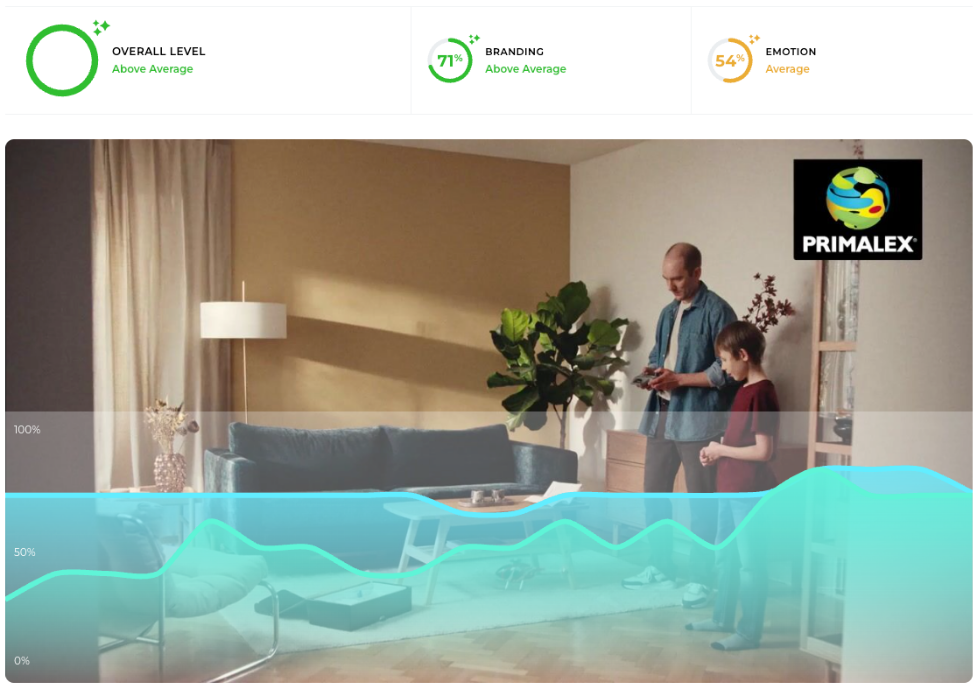
The AI Pre-Test predicted 71% brand recall, against a 53% category average.
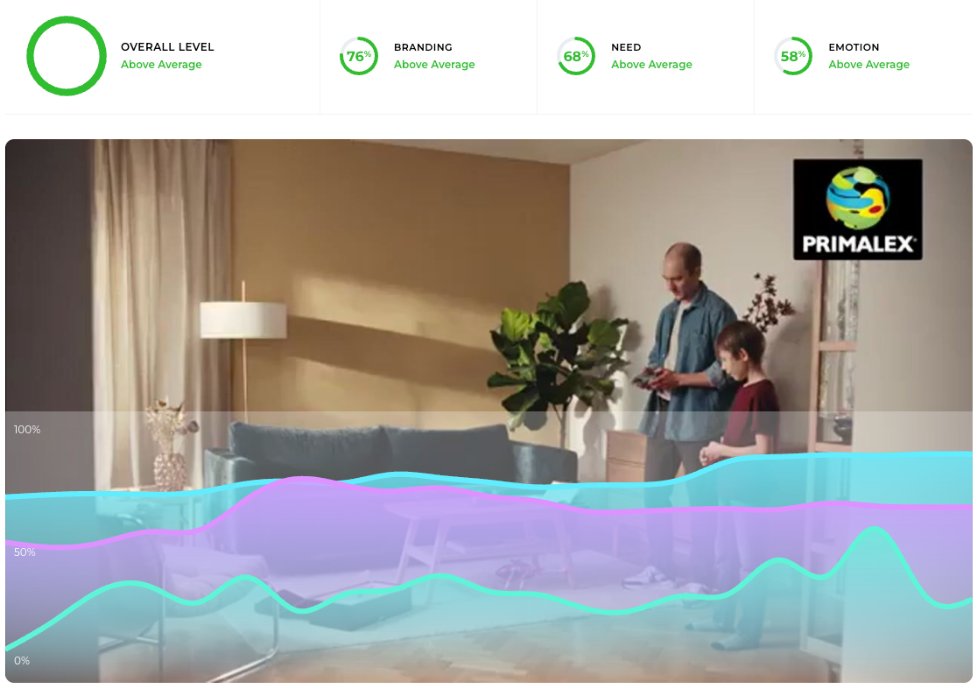
The Full Pre-Test of 500 people measured 76%.
On the metric that matters most for a paint brand fighting to be remembered, early recognition, the two were almost identical: the AI predicted 70% recall in the first five seconds, the panel measured 71%, both well above the 49% norm.
Emotion tracked the same way: 54% predicted, 58% measured, both above the 53% benchmark.
Different numbers, same call. With only the 15-minute AI read, you would have greenlit this ad with confidence. The panel confirmed it weeks later.
 AI Pre-Test
 Full Pre-Test
Magnesia: when the AI flags a limit
The Magnesia spot is a moody, cinematic piece, a film within a film. It's exactly the kind of stylized creative where a prediction model shows its edges, and that's worth being honest about.
On most metrics, the two still lined up. The AI predicted 48% brand recall against the panel's 54%. Emotion came in at 54% predicted versus 52% measured. Both graded the ad "Average." Both would have led you to the same place: solid, not standout.
But one metric split. The AI predicted 64% brand recall in the first five seconds. The panel measured 49%, a 15-point gap. The AI read the opening as more branded than real viewers did.
That gap is the useful part of the story. The AI reads a set of creative signals to predict how people respond. When an ad leans on cultural styling, unusual humor, or subtle references, real people react in ways a rule-based model can't fully call yet. That's a known limit of prediction, and it's exactly why AI ad testing is built for speed and volume, not for signing off the final cut with heavy money behind it.
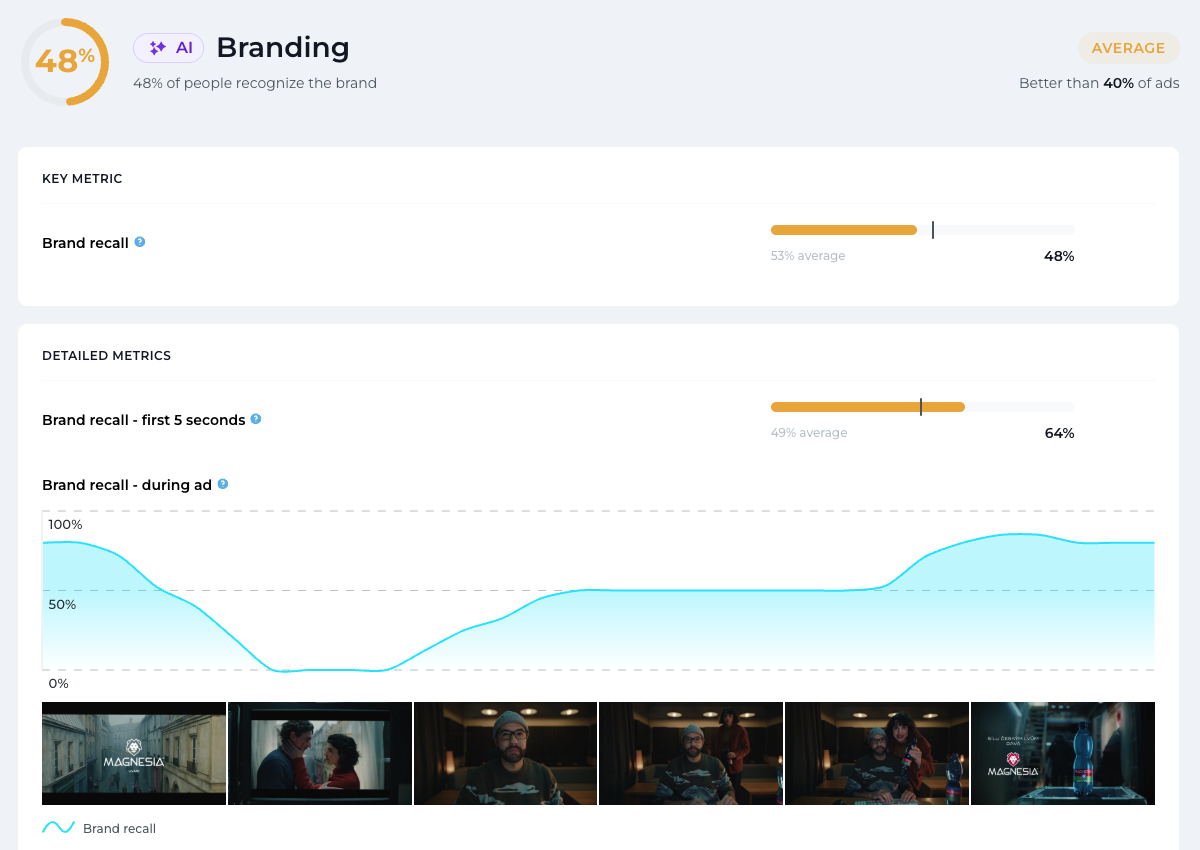 AI Pre-Test
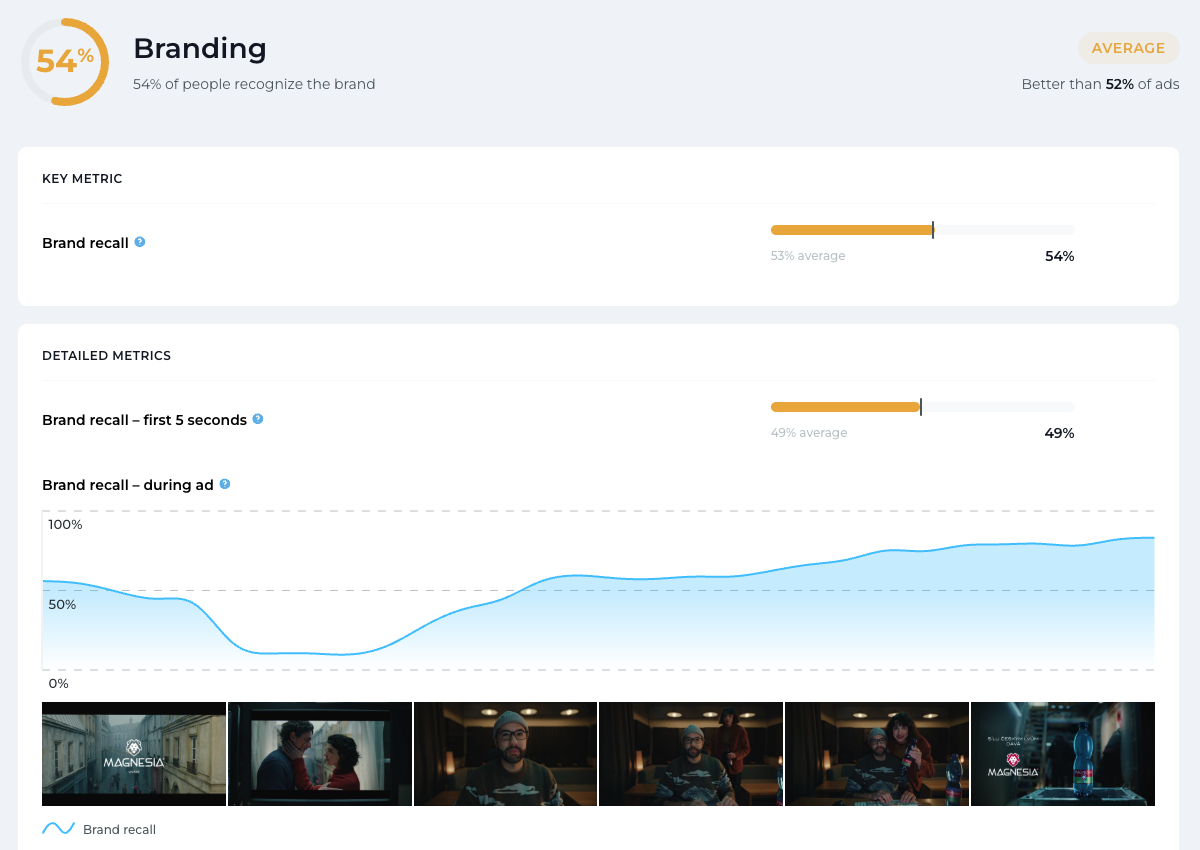 Full Pre-Test
Where AI stops and the humans takeover
The Full Pre-Test also returns a Need score, category association, that the AI Pre-Test doesn't measure yet. Primalex scored 68% on association with wall paint, against a 56% average. Magnesia scored 61% on mineral water.
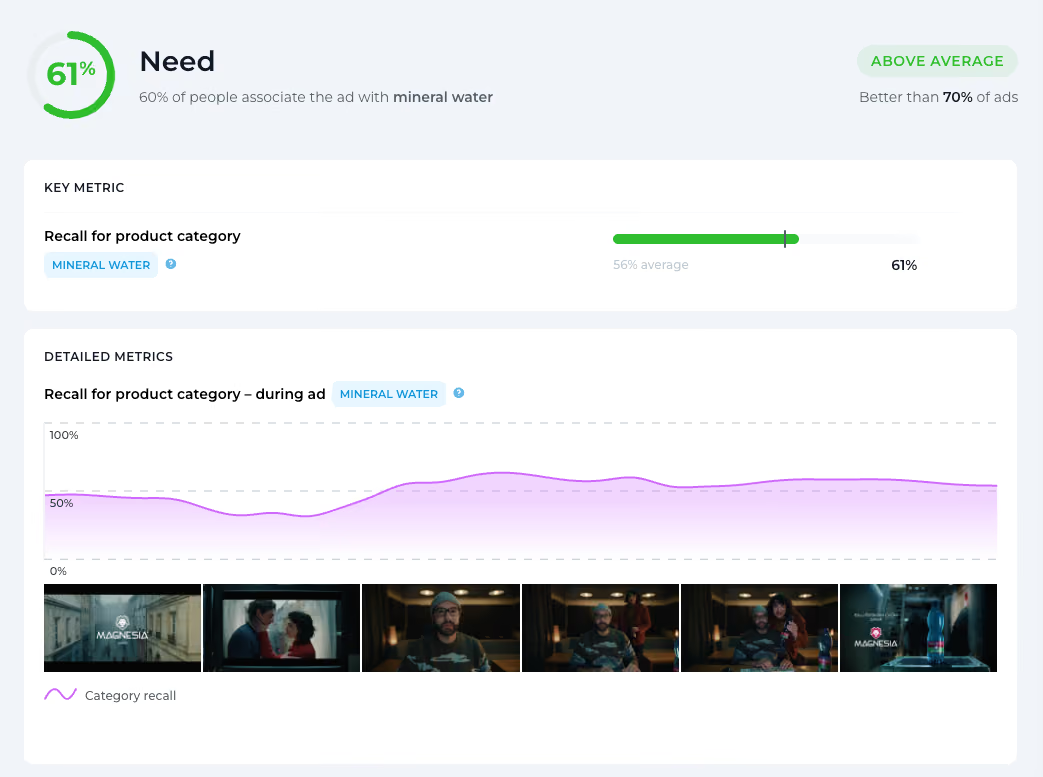
For now, the AI Pre-Test covers Branding and Emotion. Need comes later, and on purpose: getting the category definition right is a decision worth talking through before you test it, not one to hand to a model.
The AI Pre-Test screens fast and cheap. In 15 minutes it tells you whether a cut is strong, weak, or worth another pass, and it's right within 10 points 85% of the time.
The Full Pre-Test stays the source of truth for the decision that carries real money: the final cut going to air with serious spend behind it.
You don't pick one over the other. You line them up – screen everything with the AI Pre-Test, drop the weak options early, and put a Full Pre-Test behind the cut you're actually going to fund.
Same platform, two speeds. ✌️
The decision you're actually making
So, the point of AI Pre-tests is simple: they allow you to test your ad early enough to fix it, not after the budget is already spent.
- Use the AI Pre-Test to know where your creative stands in 15 minutes. Fix it while the edit is still open.
- Then put a Full Pre-Test behind the cut you're funding. That's ad testing that finally keeps up with how fast you actually work.
Want to see how your next ad scores against your category? Run it through the AI Pre-Test on Behavio's platform.
Frequently asked questions

Not entirely. AI ad testing is a strong complement to traditional methods. It's ideal for early screening and creative optimization. But for final campaign validation, especially at scale, respondent-based ad pre-testing provides a level of accuracy and statistical robustness that current AI tools cannot match.
AI prediction accuracy depends on training data quality and methodology. Tools using predictive science and implicit testing methods (measuring subconscious responses) typically outperform platforms relying on claimed preferences or historical click patterns alone. You can always validate AI predictions with in-platform performance before investing more budget into the campaign.
Prediction speeds validation, but hybrid methods that include real human data often provide deeper, more reliable insights.